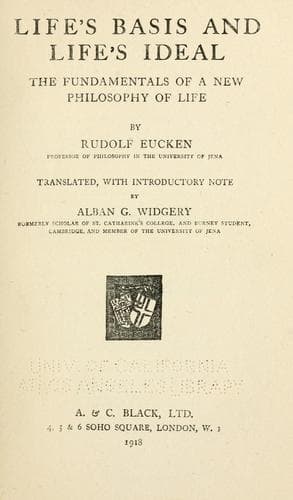
Life's Basis and Life's Ideal: The Fundamentals of a New Philosophy of LifeEucken, Rudolf
Philosophy
Life's Basis and Life's Ideal: The Fundamentals of a New Philosophy of Life
Eucken, Rudolf
Life; Ontology
These movements show life in a particular form; something emerges in it
which, unconcerned with the weal and the woe of man, follows its own
course and makes absolute demands; and, more than anything else,
disturbs and destroys his calmness and complacency. How heavily Germany
has had to pay for the movement of the Reformation by being thrown back
politically, nationally, and economically! It is inevitable that all
movements of an ideal kind, the social movement of the present included,
should appear from the point of view of natural well-being, troublesome
and pernicious disturbances. They can be regarded as something higher
only when we acknowledge that life does not consist entirely in external
relations, or in the endeavour to attain harmony with the environment,
but that an inner task grows out of life itself, and first gives to
human existence a value and a dignity.
In the development of a self-consciousness and of a movement of life
itself, we rise above the motive of utility, by which nature is swayed.
It is a moral element in the widest sense; it is the consciousness of
something objectively necessary, unconditionally transcending the ends
of the narrowly human, that first gives to convictions axiomatic
certainty and to conduct the right energy. This moral element attains to
a more independent display in the moral self-judgment of man that is
called "conscience." True, this conception has been the subject of much
error and has been much over-estimated. Not only has the moral judgment
less power over man than is frequently assumed, but that which is called
conscience is often--generally, in fact--nothing more than a by-product
of custom and of accommodation in human social life. In this case the
inner life has still attained no independence, but remains dependent
upon the environment; and the disposition thus produced is nothing more
than a feeling of aversion to the results of conduct, nothing more nor
less than concealed fear of punishment--a state of the soul which the
most prominent thinkers have, with good reason, stigmatised as a
manifestation of weakness and cowardice. But, however much that is
foreign to it and of an inferior order may have been associated with
conscience, nevertheless, judging conduct, as it does, according to the
inward disposition and not according to consequences, conscience is a
unique, original phenomenon. To whatever extent conscience, as we know
it, may have had its source in something external, and in however great
a degree it may depend upon changing circumstances, it is nevertheless
impossible to explain the fundamental fact by reference to the
environment. For, if our life depended solely and entirely upon the
environment and no movement arose from within, all influence from
without could do nothing but subdue us by sheer force; there could never
be an independent recognition and acceptance of the command addressed
to us; never the feeling of an inner responsibility for conduct; never
Public-domain text, read in full here on John Shaqi.
Reviews
Reviews
No reviews yet
Be the first to share your thoughts on this work.
Elsewhere in the archive
Join the Discussion
Join the discussion
Sign in to leave a comment or review.
Sign InorCreate an account