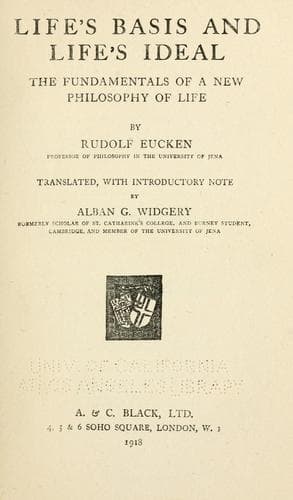
Life's Basis and Life's Ideal: The Fundamentals of a New Philosophy of LifeEucken, Rudolf
Philosophy
Life's Basis and Life's Ideal: The Fundamentals of a New Philosophy of Life
Eucken, Rudolf
Life; Ontology
Why do we refuse to adopt this view, and to discontinue an endeavour the
aims of which appear to be unattainable? In the first place, because the
movement cannot be given up so easily as those critics imagine who adopt
this view; for it does not consist simply of explanations and theories
that might be completely refuted by rigorous argument, but a certain
reality has been evolved, desires aroused, forces called into life, and
movements inaugurated. Even if they halt in their course they were
something; they do not disappear therefore before the attacks of
Scepticism; further, however mean their results may be, they prove to be
strong enough to indicate the limitations in the life of nature, and to
make it inadequate for us. The matter is the more mysterious in that the
striving is anything but a product of the natural desire for happiness.
For the movement disturbs all our complacency; it leads man to be
discontented with that which hitherto had fully satisfied him; it
surrounds him with fixed organisations; desires from him much labour and
sacrifice, and makes existence, not easier, but more difficult for him.
Delusions are wont to deceive us by pleasing pictures; to attract us
with the promise of pleasure and enjoyment. How does a delusion, that
imposes so much toil and trouble upon us, win so much power over us?
There is another matter to be considered in this connection. A complete
renunciation can appear possible only because it is not clearly
perceived how much which we cannot give up and which ultimately we have
no desire to give up is involved in it. Only a want of clearness of
thought, and still more a weakness of character, could wish to retain in
the particular case what was given up as a whole; could affirm as effect
what it denied as cause. As soon as this course is recognised to be
impossible, it becomes evident that with the rejection of the spiritual
life everything is abandoned which gives to our life dignity, greatness,
and inner unity, and joins us to others with an inward bond. Realities
such as love and honour, truth and right, must be regarded as empty
forms; and even science must come to an end, because there is no longer
any inner unity of work, no objective necessity.
Public-domain text, read in full here on John Shaqi.
Reviews
Reviews
No reviews yet
Be the first to share your thoughts on this work.
Elsewhere in the archive
Join the Discussion
Join the discussion
Sign in to leave a comment or review.
Sign InorCreate an account