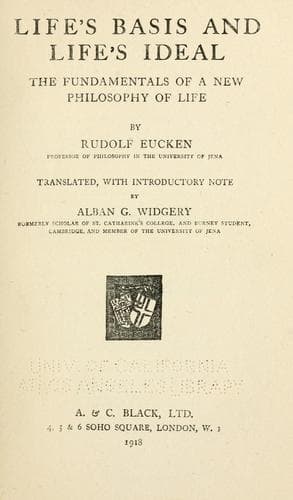
Life's Basis and Life's Ideal: The Fundamentals of a New Philosophy of LifeEucken, Rudolf
Philosophy
Life's Basis and Life's Ideal: The Fundamentals of a New Philosophy of Life
Eucken, Rudolf
Life; Ontology
Such considerations again show us that a complete negation is
impossible; and it seems that we must remain for ever in painful
suspense between an unattainable affirmation and an impossible negation.
We might be able to endure this condition of affairs if it concerned a
problem which arose in reference to something of little importance to
our life, something that we could relegate to the background, and simply
permit to lie there, without compromising our life. But our problem lies
at the centre of life; is, in fact, itself the centre. To be left in
suspense here means to condemn life as a whole to a state of paralysis,
to surrender it to complete dissolution. Against this everyone who has
any vital energy in him will contend; with his whole might he will seek
to escape from a condition so intolerable; he will not hold back from
making a bold venture, mindful of the words of Goethe, "Necessity is the
best counsellor."
In seeking a way out of the contradiction, it is essentially necessary
not to forget the source of the contradiction. We saw that source to be
in the fact that the spiritual life would set up a new world, and at the
same time remains bound up with the merely human and presents itself as
an endeavour of mere man. To the spiritual life a universal character is
indispensable; of this claim nothing can be abated. There must therefore
be a change as regards man; it must be that more comes to pass in him
than the first impression makes evident. It must be that the spiritual
within him, which seems at first to be his own product, is a
participation in wider connections; the spiritual must be operative in
man, but not originate out of the merely human. It is true that this
makes a reversal of the traditional position necessary, and not merely
of its representations; and such a reversal provokes serious doubt.
Modern science, however, has taught us sufficiently often that the first
appearance of anything need not be the ultimate one; that there may be
cogent reasons for regarding something that at first seems based in
itself as the proof of something existing beyond. Thus, modern natural
science has transformed the world of sense into a world present only to
the eyes of research. Certainly, science accomplishes these changes
within the bounds of experience: on the contrary, in regard to our
problem, in which the fundamental form of reality is in question, it is
indispensable that we should transcend these bounds; without a change in
respect of the whole, and hence without a resort to metaphysics, it is
not possible to accomplish our purpose. It is quite clear that the
tendency of our time is opposed to appeals to metaphysics: yet it is a
question how far this attitude is justified. So far as metaphysics
assumes the same form as in the past--that of conceptual speculation of
a thought hovering unrestrained over the existing world--then it is
rightly opposed. But the attitude is unjustifiable which assumes that
Public-domain text, read in full here on John Shaqi.
Reviews
Reviews
No reviews yet
Be the first to share your thoughts on this work.
Elsewhere in the archive
Join the Discussion
Join the discussion
Sign in to leave a comment or review.
Sign InorCreate an account