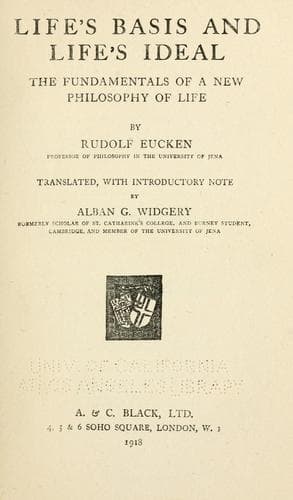
Life's Basis and Life's Ideal: The Fundamentals of a New Philosophy of LifeEucken, Rudolf
Philosophy
Life's Basis and Life's Ideal: The Fundamentals of a New Philosophy of Life
Eucken, Rudolf
Life; Ontology
Further, the taking up of the object into the life-process, the
transcendence of the antithesis of subject and object, is characteristic
of the spiritual life. But this remained an inner contradiction, a
complete impossibility so long as the spiritual life was regarded as an
occurrence in a being who, with a closed nature, stands over against
things as though they were alien; and who can take up nothing into
himself without accommodating it to his own particular nature. The
contradiction is removed only when the spiritual becomes independent;
for then both sides of the antithesis come to belong to each other and
are related to each other in a single life; and a life transcending the
division may develop, a life that produces the antithesis from within,
lives in the different sides and seeks in them its own perfection. The
life-process is now seen to be a movement that is neither from object to
subject, nor from subject to object; neither the subject's attainment of
content from the object, nor the object's becoming controlled by the
subject, but an advance of a self-conscious life in and through the
antithesis. Life, by this movement, ceases to be a single, thin thread;
it wins breadth; it expands to an inner universality. At the same time a
depth is manifested in that a persistent and comprehensive activity
emerges which lives in the antithesis. In this manner life first becomes
a life in a spiritual sense, a self-conscious and self-determining life,
a self-consciousness.
That this change is possible and brings with it a new type of life is
shown with complete clearness by experience in the separate departments
of the spiritual life. Thus, artistic creation at its highest is neither
the production of the truest possible copy of an external object, the
artist painfully abstaining from all subjective addition; nor a
presentation of subjective situations and moods, the artist endeavouring
to the utmost to avoid everything objective; but a transcendence of the
opposition of soulless objectivity and empty subjectivity by an art that
is sovereign, autonomous, and with a character of its own; the creative
activity belonging to which gives life from the soul to the object, and
moulds the soul by means of the object. This kind of artistic creation
is directed primarily towards an inner truth, not towards a truth that
is produced by the object, but one that arises only in the contact of
the object with the soul. It is manifest that creation is effected here
not as an interaction between subject and object, but above and through
this antithesis; it is only by transcending the antithesis that the
artist can give himself in his work, lend to it a soul, place an
infinity within it. In this respect conduct manifests a character
similar to that of creation. Conduct would never attain an inner
stability and enter upon an independent course, if it could not raise
itself above the opposition of a submission to orders that are forced
Public-domain text, read in full here on John Shaqi.
Reviews
Reviews
No reviews yet
Be the first to share your thoughts on this work.
Elsewhere in the archive
Join the Discussion
Join the discussion
Sign in to leave a comment or review.
Sign InorCreate an account