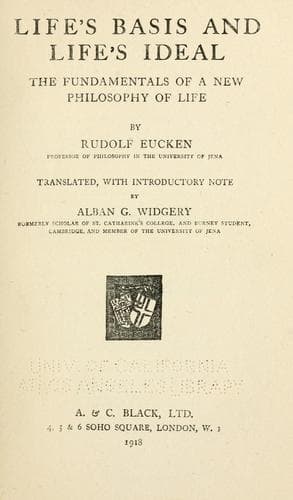
Life's Basis and Life's Ideal: The Fundamentals of a New Philosophy of LifeEucken, Rudolf
Philosophy
Life's Basis and Life's Ideal: The Fundamentals of a New Philosophy of Life
Eucken, Rudolf
Life; Ontology
upon it from without, and a mere play of subjective inclination; if it
were not able to become the self-assertion and self-development of a
life transcending that opposition. At this point also the acknowledgment
of an independent spiritual life teaches us to comprehend as a whole
that which, in a many-sided development, the different departments of
life show to be real.
The obscurity in which the conception of inwardness was hitherto
involved begins to disappear when the spiritual life is no longer
regarded as supplementary but as an independent life. It cannot be
denied that, within humanity, there is an endeavour to develop the life
of the soul to a state of self-determining activity and, at the same
time, to free that life from the bondage to sense in which it remains at
the level of nature. Yet, definite affirmation that shall correspond to
the negation of sense has been lacking; it has not been clear how
inwardness might find content and characteristic forms; there has been
no advance from the subjective to the substantial. But since a universal
activity is operative within the multiplicity and through the division,
and since it sets itself in the division and from this returns to
itself, a self-conscious inwardness becomes conceivable which has a life
of its own with new experiences. Since within this life "to receive"
presupposes the comprehending power and the self-determining activity of
a vital whole, something other than sense is able to evolve and through
all the persistence of sense to become the chief matter. The spiritual
life is not directed to a reality adjacent to it, but evolves a reality
out of itself; or rather, it evolves as a reality, a kingdom, a world;
and so it advances from vague outline to more complete development; it
struggles for itself, for its own perfection, not for anything external.
It is directly implied in the above conception that the spiritual life
is something different from single psychical functions, such as
cognition, volition, and the like; and that man, so far as he shares in
it, is more than one such function or a sum of such functions. For these
functions come under the antithesis of subject and object, while the
spiritual life transcends it. It is also clear that the spiritual life
does not change this or that in a life which already exists, or add this
or that to it, but that it introduces a new kind of life--a life by
which man is distinguished clearly from everything inferior to him.
Public-domain text, read in full here on John Shaqi.
Reviews
Reviews
No reviews yet
Be the first to share your thoughts on this work.
Elsewhere in the archive
Join the Discussion
Join the discussion
Sign in to leave a comment or review.
Sign InorCreate an account