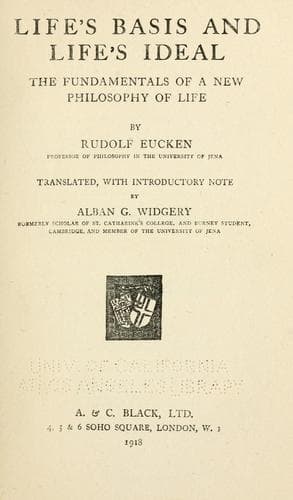
Life's Basis and Life's Ideal: The Fundamentals of a New Philosophy of LifeEucken, Rudolf
Philosophy
Life's Basis and Life's Ideal: The Fundamentals of a New Philosophy of Life
Eucken, Rudolf
Life; Ontology
If the spiritual life is an evolution of a reality in the life-process,
then the question arises as to how this reality is related to the world
that immediate experience shows us to be surrounded by. As surely as man
in his subjective reflection is able to free himself from the world and
to place himself in opposition to it, so there can be no doubt that the
spiritual life belongs to the permanent reality of the world and, as we
see it, grows up out of its movement. The transition to an independent
inwardness is not something which happens externally to the world but
within it: no special sphere, separate from all the rest, is originated;
but reality itself evolves an inner life: it is the world itself that
reveals a spiritual depth, or, as we might say, a soul. We are not
justified in doubting and attacking this view simply because the
spiritual life meets us only in man, and thus, in contrast with the
infinity of nature, is in its external manifestation so insignificant.
For something essentially new appears in it, something that involves
another order of things: the fact that little falls within our range of
vision is in this connection not at all relevant. If anyone is disturbed
and driven to denial by the external insignificance of the
manifestations of the spiritual life, he shows only that he
misunderstands what is distinctive and revolutionising in that life. The
spiritual life is not to be thought of merely in reference to the
experiences of the individual, but also to the work of humanity, to
history, to the advance of culture. All these show us a development of
life that presents the world from a new side; and this must be an
important factor in the estimation of the world, especially if the
spiritual is recognised as having a life independent of man.
The inward must necessarily present itself as the fundamental and the
comprehensive; as that which in its invisibility sustains, dominates,
and unifies the visible world. Nature, which there was a tendency to
regard as the whole, is now of the essence of a wider reality and a
stage in its development; and it is impossible for the conception formed
from it to be regulative of the whole. Ultimately, therefore, reality
cannot be regarded as something dead, detached, and given: it signifies
to us something living, something experienced in itself, something
sustained by incessant activity. At the same time, the lateness of the
appearance of the spiritual life within our realm and the many ways in
which this appearance is conditioned force us to acknowledge that the
life of the world as a whole has a history. The conception of history
that we have become familiar with in its application to nature and to
the spiritual life throughout is now extended to the relation between
the two. However many mysteries it yet involves, definite progress in
our conception of the world must be admitted.
Public-domain text, read in full here on John Shaqi.
Reviews
Reviews
No reviews yet
Be the first to share your thoughts on this work.
Elsewhere in the archive
Join the Discussion
Join the discussion
Sign in to leave a comment or review.
Sign InorCreate an account