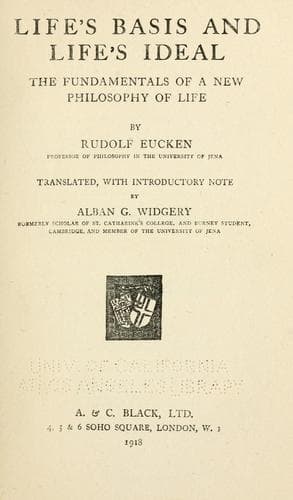
Life's Basis and Life's Ideal: The Fundamentals of a New Philosophy of LifeEucken, Rudolf
Philosophy
Life's Basis and Life's Ideal: The Fundamentals of a New Philosophy of Life
Eucken, Rudolf
Life; Ontology
The naturalistic systems do the same thing in a different way, and this,
indeed, in contradiction to their main contention. For, when they
attempted to produce a system from themselves, they could achieve their
object only in that they were implicitly based upon the spiritual life,
and introduced again indirectly that which they had previously rejected.
They are developments of the spiritual life in particular directions and
under particular circumstances: they think that they are able to
accomplish out of their own resources something which they accomplish
only with the help of a fundamental spiritual life; and so the more
consistent they are in their denial of an independent spirituality the
more inevitably they lose all internal coherence.
Thus from whatever point we start we come to the question of an
independent spirituality; an answer to this question is involved in
every system of life. But as its implications are not distinctly
recognised, it does not receive its proper due. If we consider the
question adequately, it will be found that a universal life must precede
all differentiation and division; and that from this life each movement
must receive a new elucidation. A multiplicity within the whole is quite
intelligible, because it is a development of the spiritual life, not
absolutely, that is in question, but in relation to the position of man
and under the conditions to which he is subject. The desire to give
greater stability to our life in opposition to the never-ceasing flow of
appearances that constitutes our immediate existence, also compels us
strongly to emphasise the importance of the relation to the spiritual
life, which is acknowledged as independent. Without an elevation above
this constant change all spiritual work must inevitably become
disintegrated, and no truth of any kind would be possible to us. In the
Modern Age especially there is a keen desire for a firm basis, as a
secure support of life as a whole. But it is useless to seek this basis
in life as we immediately experience it, whether in thought, in
activity, or in anything else; for in the whole life of immediate
experience there is nothing that is free from change. To seek this basis
in a particular point is also to no purpose, even if one could be raised
to a position above change; for it could not operate beyond itself in
such a way as to support the rest of life. If, therefore, we would not
submit to a dissolution of life, we must seek a basis for it beyond its
immediate state and in a whole of life. Such a whole of life is offered
only by the spiritual life, which, transcending man, is also immanent in
him. Of course this cannot be taken possession of immediately at the
beginning of the journey of life; but it is held up to us as an aim, and
we can only gradually approach it. But how could it operate within us
thus, if our life had not some kind of participation in it from the
beginning; if our life were not in some way based in the spiritual life,
Public-domain text, read in full here on John Shaqi.
Reviews
Reviews
No reviews yet
Be the first to share your thoughts on this work.
Elsewhere in the archive
Join the Discussion
Join the discussion
Sign in to leave a comment or review.
Sign InorCreate an account