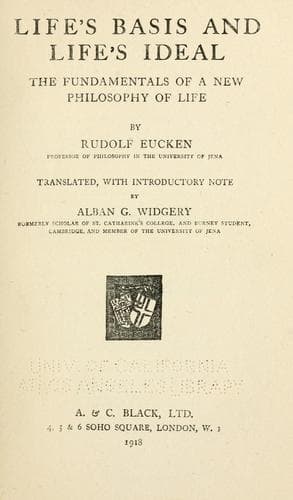
Life's Basis and Life's Ideal: The Fundamentals of a New Philosophy of LifeEucken, Rudolf
Philosophy
Life's Basis and Life's Ideal: The Fundamentals of a New Philosophy of Life
Eucken, Rudolf
Life; Ontology
and in progressive activity only developed the spiritual that is in it?
For unless we are based in the spiritual life we should drift helplessly
to and fro in uncertainty, and our endeavour would never be
intelligible. From this point of view also, our relation to the
spiritual life is seen to be the fundamental problem that must precede
all others.
If there can be no doubt that the problem of life is comprehended most
universally when we view it in relation to the spiritual life, there may
be all the more uncertainty whether all characteristic form and, with
it, all deep-reaching effect are not lost by reason of this
universality. If the conception of the spiritual life involved its usual
vagueness, this would in reality be the case, for recourse to it would
not effect any fundamental transformation of the immediate condition of
life; and we should not rise above the mere combination of its various
movements. The case is quite otherwise if the spiritual life is
distinguished clearly from the human and is acknowledged to be an
independent world. So understood, it must show a particular content, a
new structure of life, and must give a distinct form to everything that
it takes up into itself. It is necessary to consider, also, its relation
to the world of sense, and we may expect to be faced in this matter with
complications and problems that will agitate our life in its whole
extent, and set it in a new light.
In the spiritual life we recognised a new world, a realm of inwardness,
which has become independent. Within this realm life cannot be directed
to something alien, but can be occupied only with itself, with its own
development. Its experiences cannot be related to externals; they must
lie in itself. Now, have we any knowledge of a movement that reaches
back in this manner to the elements of life? We perceive a movement of
this kind clearly enough. In the first place, all development of the
spiritual life shows, even within the individual, the attribute that a
universal mode of thought, conviction, disposition, sets itself in the
single function and continues present within it. The tendencies and
manifestations of the spiritual are not all at the same level of
development, but since a universal activity, a comprehensive and
persistent deed, is present in the particular manifestation, the process
acquires a depth, and a single act is able to give expression to a
tendency of the whole as well as to react upon it.
Public-domain text, read in full here on John Shaqi.
Reviews
Reviews
No reviews yet
Be the first to share your thoughts on this work.
Elsewhere in the archive
Join the Discussion
Join the discussion
Sign in to leave a comment or review.
Sign InorCreate an account