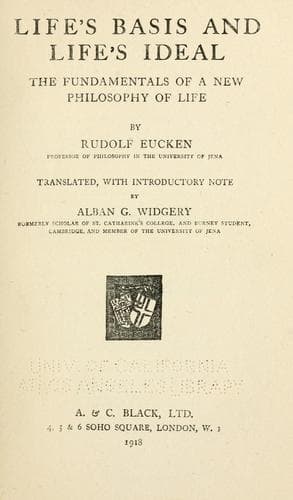
Life's Basis and Life's Ideal: The Fundamentals of a New Philosophy of LifeEucken, Rudolf
Philosophy
Life's Basis and Life's Ideal: The Fundamentals of a New Philosophy of Life
Eucken, Rudolf
Life; Ontology
We shall consider the question of the possibility of this almost
immediately: so much, however, is certain--that this necessity of a
decision by man himself makes the matter far more complex and of far
greater risk. The establishment of an independent spiritual life in man
finds its chief enemy not in nature, but in the limitation and
perversion of spiritual impulse through man's subordinating it to his
own ends. The chief conflict is not between spirit and nature, but
between real and false spirituality. Thus thought emerges in man, seeks
a representation of the world and would in this attain to truth; but
when this striving first appears, man is wont to treat himself as the
central point of the whole, to measure the whole of infinity according
to what it achieves in relation to him, and to see reflections of
himself throughout its whole extent. And so we have the anthropomorphic
way of thinking, the nature of which we have become aware of only
through toil during the progress of the work of culture; a way of
thinking from which it has needed even more toil to protect ourselves,
and which, in forms often hardly noticeable, is ever ready to appear
again and to draw the spiritual movement into its paths. With the
emergence of the spiritual life, man becomes more free in relation to
his environment; more free also in relation to the necessities of mere
nature: his activity can exert itself more independently, concern itself
with lofty aims, strive towards the infinite. But all this capacity
becomes drawn into the service of the human; the wishes and the desires
of the individual grow to an enormous extent. Since out of the struggle
for existence, with its natural limitation, an interminable struggle for
more existence arises, naïve self-preservation becomes transformed into
an unrestricted egoism. That the more-than-human which appears in the
domain of man should be employed to the advancement of the merely human
is a danger that is present even at the highest stages of development:
at one time man would prove his own power in the more-than-human; at
another, and this more especially, he treats it as a means to attain his
material welfare. Religion, for example, would reveal to man a new depth
of reality, and so create a new life for him; and yet, how often even
this new reality is degraded to a means for the preservation of his
insignificant personality, and regarded as something which on his behalf
guides the whole world aright!
Public-domain text, read in full here on John Shaqi.
Reviews
Reviews
No reviews yet
Be the first to share your thoughts on this work.
Elsewhere in the archive
Join the Discussion
Join the discussion
Sign in to leave a comment or review.
Sign InorCreate an account