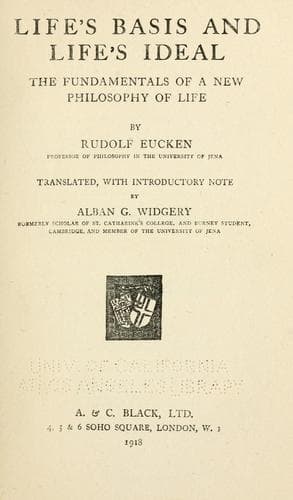
Life's Basis and Life's Ideal: The Fundamentals of a New Philosophy of LifeEucken, Rudolf
Philosophy
Life's Basis and Life's Ideal: The Fundamentals of a New Philosophy of Life
Eucken, Rudolf
Life; Ontology
The development of the spiritual life in the human sphere can thus be
seen to be anything but a sure and steady progress; every step forward
brings new dangers; unutterable confusion arises through the use and the
perversion of the new in the interests of man. But, if the development
of the spiritual life within man is thus an unceasing conflict against
human error, this conflict, despite its exhibition of the littleness of
man, is at the same time a witness to his greatness. For it shows not
only that the spiritual movement needs the active co-operation of man,
but also that there is a conflict within humanity itself against the
perversion of the spiritual; that there must be more within man and
operative in him than the narrowly human. Indeed, in nothing does man
seem greater than in this development of a more-than-human within the
domain of man, in this severe and untiring conflict with himself. How
could this conflict arise and become the soul of universal history if
man did not possess a life and being transcending his particularity, and
if he did not realise more in himself than we at the first glance see in
him? The error of Positivism is that, although it shows most clearly how
this spiritual movement dissolves the forms of life as it is immediately
experienced, it does not perceive and value the fact that, at the same
time, a new life, an inner life emerges; that, indeed, the negation
itself is possible only through a more comprehensive spiritual
revelation. To consider the negative and the positive in their relation
to each other, and to weigh them one against the other, is the
indispensable condition for the adequate understanding of human life.
(b) _The Nature of Freedom_
The arousing of a new world to life within man is a problem and a task:
it cannot be effected unless the spontaneity and self-determining
activity that are distinctive of this world also manifest themselves
within him. Further, it cannot be effected unless within man, who with
the greater part of his being belongs primarily to nature, a deliverance
from nature is accomplished and the centre of life is removed to its
spiritual side; and this cannot happen without the co-operation of man.
We need freedom, therefore, in two senses: as the presence of an
independent inner life, and as man's capacity to change--and we cannot
fail to recognise that these are closely related.
Public-domain text, read in full here on John Shaqi.
Reviews
Reviews
No reviews yet
Be the first to share your thoughts on this work.
Elsewhere in the archive
Join the Discussion
Join the discussion
Sign in to leave a comment or review.
Sign InorCreate an account