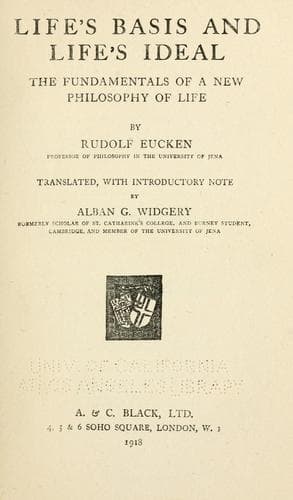
Life's Basis and Life's Ideal: The Fundamentals of a New Philosophy of LifeEucken, Rudolf
Philosophy
Life's Basis and Life's Ideal: The Fundamentals of a New Philosophy of Life
Eucken, Rudolf
Life; Ontology
Where inner unity and such an activity are lacking, a true present does
not exist. For if, through the all-dominant relation of cause and
effect, that which comes later proceeds in certain sequence from that
which came earlier, our whole existence is only a stream of occurrences,
and that which is called present is nothing more than the point of
transition from the past to the future. Now, a real present can be
reached from such an apparent present only if an independent task
originates at this point, and a decision has to be made: the more our
whole life and being here become a problem again, the more securely
might we trust to the possibility of advancing beyond all previous
achievement, and of a spontaneous breaking forth of new powers, the more
will our life be transformed into a genuine present. A genuine present
does not exist within the sequence, but above it; it cannot come to us
opportunely, but must be attained through our own activity: it is our
own work. It is, therefore, not a common and equal possession, but is
differently constituted according to the individual. The present is the
more real and comprehensive for us the more spiritual power we evolve
and the more spiritual content we give to life. Thus the present is not
a mere point in the succession of times, a mere ripple in the stream of
appearances, but involves a counteraction to this flow; its formation is
to be accomplished only by the placing of life in the region of the
spontaneous, the independent, the time-transcendent.
All the losses in individual matters are, however, only appearances and
parts of a universal loss that the surrender of freedom involves. This
loss is no other than that of an independent nature-transcending
spiritual life in general. Spontaneity is no subsidiary quality, the
disappearance of which might only involve a modification; with it, the
spiritual life as a whole stands or falls. The experience of history
also shows clearly enough that that which has in any way reached a
spiritual height never persists by simply existing, but that, if it is
not to degenerate rapidly, it must proceed ever anew from spontaneous
creative activity. The law of nature, that everything remains in its
existent state of rest or motion until it is acted upon from without, is
not true of the spiritual: of it nothing abides that is not continually
brought forth anew.
The surrender of freedom, therefore, means no less than the inner
destruction of the spiritual life. And before we submit to this we shall
feel compelled to make a more careful inquiry, to see whether the
arguments against freedom are really so cogent as they are represented.
They do exert a compelling force, but only so long as their
presuppositions are admitted and held to be unassailable. That they are
not unassailable will become evident as soon as we clearly recognise
their nature and implications.
Public-domain text, read in full here on John Shaqi.
Reviews
Reviews
No reviews yet
Be the first to share your thoughts on this work.
Elsewhere in the archive
Join the Discussion
Join the discussion
Sign in to leave a comment or review.
Sign InorCreate an account