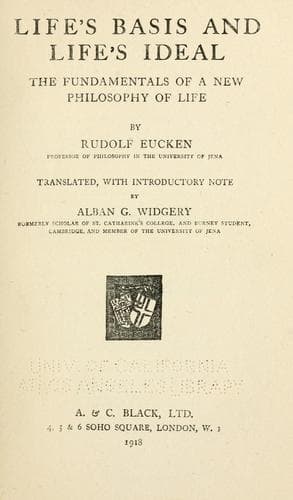
Life's Basis and Life's Ideal: The Fundamentals of a New Philosophy of LifeEucken, Rudolf
Philosophy
Life's Basis and Life's Ideal: The Fundamentals of a New Philosophy of Life
Eucken, Rudolf
Life; Ontology
However, our attitude in regard to this problem has, indeed, been
essentially changed by modern thought. There can be no further talk of a
vague freedom of the will, of a capacity to act in one manner or
another unaffected by anything that preceded and by the whole
environment; the fact of the subjection of man to a destiny, both
external and internal, is forced upon us with overwhelming power.
Whether the idea of freedom in every sense is shown to be invalid is
another question; perhaps the problem is not so much solved as put on
one side. In any case, if a fundamental problem--one that has been
discussed from the earliest times--is suddenly declared to be finally
solved, the suspicion must soon arise that the solution appears to be
self-evident only because certain presuppositions which are in no way
self-evident are implicitly assumed in it.
The surrender of every kind of freedom meets in the first place with the
suspicion that thereby far more is lost than we think or intend; that
much is lost to which it is impossible to surrender all claim. Great
trouble is taken to prove that the denial of freedom by no means does
away with the possibility of an ethical moulding of life. Yet it might
be shown without difficulty that, in attempts of this kind, either the
freedom, rejected in its ordinary sense, finds entrance again altered
and deepened--as, for example, in the philosophy of Spinoza--or the
ethic that remains after freedom has been denied retains only the name,
and in itself signifies something merely mechanical. But why do we
insist upon the ethical; why does so much depend upon its continuance?
For this reason: that upon it depends whether life merely _happens to_
us or also _from_ us; whether we are simply parts of a rigid
world-mechanism or self-determining co-operators in the building up of
reality. If the former hypothesis is true, we are no more than the
platform upon which events become connected; and we can possess no other
unity than a summation of the multiplicity. A unity of this kind could
not possibly attain to independence and transcendence; could not make an
inner judgment upon events; could not take up a conflict in opposition
to the condition of life as it is immediately experienced. The
conception of conduct would inevitably be degraded to that of mere
occurrence. We should cease to have inner unity and be comprehensive
selves; we should not be able to speak of disposition and conviction:
for it is of the essence of all these things that they cannot be
imparted, but must arise newly and spontaneously just in the individual,
and for this a concentration of life, an elevation to self-conscious and
self-determining activity, is necessary.
Public-domain text, read in full here on John Shaqi.
Reviews
Reviews
No reviews yet
Be the first to share your thoughts on this work.
Elsewhere in the archive
Join the Discussion
Join the discussion
Sign in to leave a comment or review.
Sign InorCreate an account