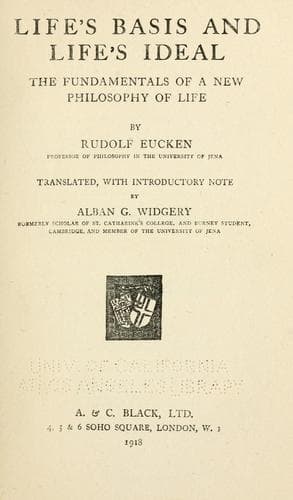
Life's Basis and Life's Ideal: The Fundamentals of a New Philosophy of LifeEucken, Rudolf
Philosophy
Life's Basis and Life's Ideal: The Fundamentals of a New Philosophy of Life
Eucken, Rudolf
Life; Ontology
It is true that the possibility of an elevation has its fixed
conditions; it necessitates particular convictions with regard to the
world and to man. We must view the world as being still in a state of
flux and regard man as not being simply a closed and limited individual.
The infinite spiritual life must be present as a whole to him, and
arouse a new world to life in him; his conduct must be rooted in the
power and content of the infinite life: only thus can we understand that
in man also a movement begins and a change is brought about. And so it
remains ever an inderivable, original phenomenon, which we must
acknowledge as a fact, that a spontaneous life breaks forth in man, a
new and relatively independent life-centre originates. We always come
back in the long run to original phenomena; the origin of living being
in general is also an original phenomenon. May we deny the fact of such
original phenomena, because they make our representation of the world
less uniform and simple? To do so would be nothing else than to make our
previously formed conceptions the measure of reality; it would be a new,
specifically modern anthropomorphism.
This freedom, with its requirement of a world of inner life that
introduces new contents, and also that we belong in some way to this
world, is by no means a capacity to make a decision capriciously at any
moment; it is not a denial of the power of necessity. Of course, it
implies that there may be some kind of counteraction to this necessity;
and that if this counteraction can attain success only as a result of
the activity of life as a whole, even the individual moment need not be
a matter of indifference. For, as the spiritual life has always to win
its own height anew, so the present in its relations is not a mere
consequence of the past: times of temptation can come repeatedly when
all that which has been achieved becomes doubtful again; but times of
elevation also come when an advance is made beyond that previously
achieved. It is not possible for us simply to reject the present
existence and all the conditions which constrain us, and to choose for
ourselves a new kind of existence, instead of the one we have; from that
it is impossible to free ourselves: in all further endeavour we have to
take it into account, to make our peace with it. Nevertheless, life can
attain to a transcendent point of view, from which the world of sense
becomes the object of judgment and of adaptation; from which, to be
regarded as completely ours, it needs acknowledgment and appropriation
by us; and from which it is seen not to constitute our whole life, as
that which is ultimate. Indeed, the tendencies within us which are
concerned with nature, first reach their highest through such
acknowledgment and appropriation by us: placed on a spiritual basis they
lose their rigid exclusiveness and become unified; our particular nature
no longer constitutes our whole being, but becomes the central point of
Public-domain text, read in full here on John Shaqi.
Reviews
Reviews
No reviews yet
Be the first to share your thoughts on this work.
Elsewhere in the archive
Join the Discussion
Join the discussion
Sign in to leave a comment or review.
Sign InorCreate an account