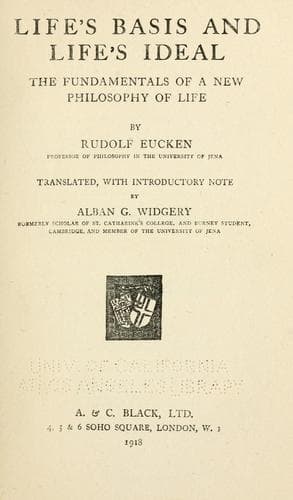
Life's Basis and Life's Ideal: The Fundamentals of a New Philosophy of LifeEucken, Rudolf
Philosophy
Life's Basis and Life's Ideal: The Fundamentals of a New Philosophy of Life
Eucken, Rudolf
Life; Ontology
a more comprehensive life, which extends further and further to
infinity.
Our life, therefore, is a conflict between fate and freedom, between
being "given" and spontaneity; and this conflict may be followed through
all life's divisions. The conflict appears primarily in the individual
in the development towards personality and spiritual individuality. For,
as personality, unless life has a spontaneous source, is an empty word,
so also spiritual individuality does not come to anyone, but has first
to be won by the work of life essentially elevating that which destiny
brings: so far, it is our own work; but it is not entirely our own work,
because that which comes to us from nature, and the condition of life
gives us fixed points of support and points out a certain course.
Similarly, peoples have in their nature, environment, and history
definite conditions of their being, from which they cannot withdraw. But
spiritual creation and inward greatness do not grow simply out of these
conditions, however favourable they may be, but out of a spontaneous
activity which takes up that which has been presented to it, gives it a
central point, and from this develops it. The deciding question is
always whether and how far individuals and peoples attain to and
preserve such a self-determining activity. This activity alone makes it
possible for life to be unified inwardly; for its elements to be
distinguished and separated, and for some to be brought into prominence
and others relegated to the background; for life to be made secure and
elevated, and as the result of all for a spiritual individuality to be
formed. The same thing holds good of the condition of a particular time,
and man's relation to it. At first man appears to be a child of his age,
a slave of his age. But by the spiritual life he is able to win an
independence of the age, and to make himself its lord. Again, he cannot
free himself from the problems of the age; he cannot alter them just as
he likes, cannot divert into an opposite direction the power which they
exert upon him. But there is always an "either--or," either submission
to the succession of experience, or the beginning of an opposition from
spiritual self-determining activity: in this, also, the possibility of
calling new powers to life presents itself. From this spiritual point of
view activity centred upon the concerns of the particular age is no
longer regarded as the whole life; the particular age with its work is
comprehended in an infinite life. As through all its different stages
and constituents, so ultimately humanity as a whole also carries on a
struggle for a spiritual being, an advance to a new level. Humanity may
not be regarded as something finished; it must evolve to a nature other
than its present one, bring about a transformation of its life, and win
a spiritual individuality: the life of humanity is in a state of motion
and it must become self-determined.
Public-domain text, read in full here on John Shaqi.
Reviews
Reviews
No reviews yet
Be the first to share your thoughts on this work.
Elsewhere in the archive
Join the Discussion
Join the discussion
Sign in to leave a comment or review.
Sign InorCreate an account