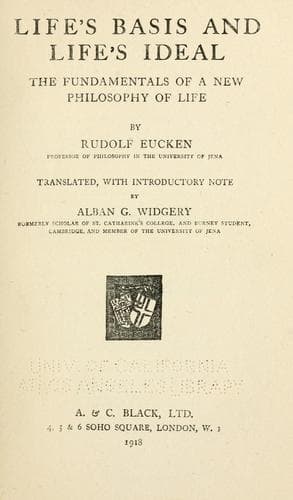
Life's Basis and Life's Ideal: The Fundamentals of a New Philosophy of LifeEucken, Rudolf
Philosophy
Life's Basis and Life's Ideal: The Fundamentals of a New Philosophy of Life
Eucken, Rudolf
Life; Ontology
The nineteenth century transmitted to us a conception of history that is
far more peculiar in nature and far more open to attack than is usually
recognised: history is represented as a great stream which takes up all
individual achievements into itself, unites them, and, regardless of all
human error and caprice, leads surely to its end. No genuine achievement
is lost, and all gain seems to be permanent; beyond all the trouble and
uncertainty of the moment appeal is made to the power which, directing
and elevating, permeates the movement, clarifies and refines it. In this
conception the necessity of a process that has the power of determining
its own activity and making its own decision is primary. The fact that
the matter is not so simple as this conception of history represents is
shown by the experience of the age itself, which directly contradicts
it. For according to this conception the whole past should discharge
itself into the present and so impart its whole result immediately to
us, and the direction that our activity ought to take should be pointed
out to us with complete certainty by history. But we are distinctly
aware of the extent to which this direction is a matter of question and
doubt, and of the uncertainty into which we have fallen with regard to
the relation of the present to the past: in the process of our
investigation we saw this in particular in the division and conflict
between the different systems of life. History is seen to be a difficult
problem far more than a secure fact; and we are compelled to take up a
new consideration of the question.
In this consideration a distinct delimitation of the achievements
characteristic of man is primarily necessary. Modern science already
recognises a history of nature, and much that was formerly regarded as
complete is now seen to be in a state of flux and movement. Since every
event leaves effects behind, in the course of ages the results
accumulate, develop, and act upon one another, that which comes later is
conditioned by the influence of the earlier and is intelligible only in
relation to it, a distinctive historical method gains currency. Geology
presents to us with particular clearness a history of this type. In so
far as man belongs to nature and the spiritual life has not yet
developed to any degree of independence in him, he is also the subject
of such a history. That which happens within him leaves behind effects
that become the conditions of later occurrence. This conception of
history, as determined solely by mechanical causes, is still maintained
in some quarters in spite of further developments of thought. But it is
not apparent from this point of view how, even with the greatest
accumulation of effects, history could yield anything of gain to an
inner unity, to a life from the whole: for that, man must bring with him
something essentially new; and as a matter of fact this is what he does.
Public-domain text, read in full here on John Shaqi.
Reviews
Reviews
No reviews yet
Be the first to share your thoughts on this work.
Elsewhere in the archive
Join the Discussion
Join the discussion
Sign in to leave a comment or review.
Sign InorCreate an account