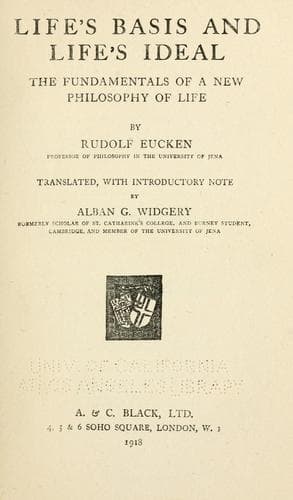
Life's Basis and Life's Ideal: The Fundamentals of a New Philosophy of LifeEucken, Rudolf
Philosophy
Life's Basis and Life's Ideal: The Fundamentals of a New Philosophy of Life
Eucken, Rudolf
Life; Ontology
Not only do events happen to us and change our condition, but with our
own activity we are able to hold fast to these events, to give to them
an inner permanence, to bring them ever anew from the dim distance into
the living present. We do not drift onward with the stream of time, but
withstand it; seek to wrest something fixed from "becoming" and change,
and salvation in the eternal. We cannot do this without altering the
whole view of things and manifesting a new spiritual capacity.
The retention in mind of individual events by means of annals, monuments
and similar methods is the beginning of a history of a higher kind: even
so much shows a greater activity, since it involves a judgment of the
significance of events, and on the basis of this judgment begins to
wage war against the destroying power of "cormorant devouring time." The
achievement is incomparably higher, if certain spiritual unities and
tendencies are adhered to and are given permanent currency: thus
religion in particular gave a stability to life and delivered men from
the tyranny of the mere moment. The matter remains simple so long as the
movement is within a single people or a definite sphere of culture. But
in its progress it goes far beyond these limits. New peoples arise; the
state of culture undergoes great changes, indeed revolutions; life is
taken up from new starting points, from which everything of importance
to earlier ages loses its value. But it is lost only for a time; a
desire to return to it and to bring it into complete harmony with the
new is soon felt. The circle of vision is thus increasingly widened, and
all multiplicity is finally united into a whole. This retention of the
past is primarily a matter of knowledge and of intellectual
appropriation. But it is not limited to this; it would operate not only
in the extension of knowledge but beyond this in the development of
life. Whatever has been won by human power is to be preserved, unified,
and used to advance the present. Thus, there arises a historical
culture; an education on a historical basis; religion and philosophy,
art and law derive power and content from the work of universal history,
and life as a whole seems to win a greater comprehensiveness and
stability. And so it has come to appear as though the past imparts its
whole result to the present without any effort on the part of man and
without incurring him in any risk.
Public-domain text, read in full here on John Shaqi.
Reviews
Reviews
No reviews yet
Be the first to share your thoughts on this work.
Elsewhere in the archive
Join the Discussion
Join the discussion
Sign in to leave a comment or review.
Sign InorCreate an account