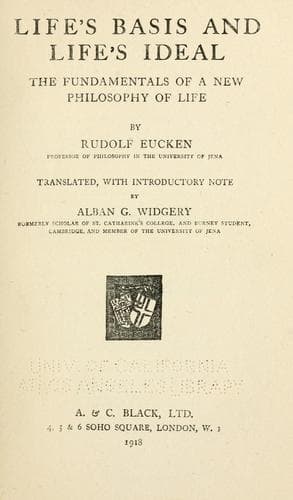
Life's Basis and Life's Ideal: The Fundamentals of a New Philosophy of LifeEucken, Rudolf
Philosophy
Life's Basis and Life's Ideal: The Fundamentals of a New Philosophy of Life
Eucken, Rudolf
Life; Ontology
This movement of life in history involves more unrest, conflict and
doubt, than the nineteenth-century doctrine of evolution implied. For
this doctrine saw in the historical movement the unfolding of a
spiritual life, sure as regards its foundation and its main direction;
the antitheses within that movement seemed to be involved in a single
process, which determined the limits of each tendency in relation to the
others; a transcendent necessity was regarded as leading to the
development of all in their relation to one another. As a fact, the
conflict is also concerning the substance and the main direction of the
whole; the spiritual life must first realise itself within the region of
mankind, and it is realised through the toil and work of man himself. It
is just the fact that the problem is an ultimate one, that even the
fundamental forms of life develop only in conflict and experience, and
that we are concerned not with winning simply this or that in life, but
genuine life itself, that makes history significant. At the same time,
this brings man into a more inward relation to the spiritual life, and
this life is made more his own life and being than if he were
surrounded by the power of physical or intellectual processes. Nothing
makes humanity as a whole more significant than that in its province and
through its work the new world begins to develop.
With such a conception of history, the philosophical treatment of it
must direct its attention chiefly to the independent spirituality which
in the course of the centuries, and especially in great changes, is
evolved in contrast with the narrowly human; and to the main direction
which is given to life by this spirituality. The philosophical treatment
of history ought first of all to trace the liberation of life from the
simply human; the inner elevation of our being to a more-than-human.
Antiquity at the height of its spiritual development began to desire a
universal truth independent of man; a moulding of life in accordance
with an inner right; and an order of things beyond the power of human
caprice, as was shown by the giving symmetry and harmony precedence in
art, and justice in conduct. Christianity brought about a liberation of
the innermost disposition, the root of endeavour and of love, from
purely natural impulse, however ennobled; and in this way brought men
into new relationships and set them before new tasks. The Modern Age on
the part of science began a relentless conflict against the
anthropomorphism of the mode of life as immediately experienced; thus it
has made the spiritual life even in its form independent of man, in that
it has created spiritual complexes and has recognised in them movements
and inner necessities of their own. Through the whole of this movement
of universal history life frees itself more and more from its dependence
upon mere man, and from the bondage to "given" presuppositions and
"given" natural impulses, and from a "given" world in general. Life is
Public-domain text, read in full here on John Shaqi.
Reviews
Reviews
No reviews yet
Be the first to share your thoughts on this work.
Elsewhere in the archive
Join the Discussion
Join the discussion
Sign in to leave a comment or review.
Sign InorCreate an account