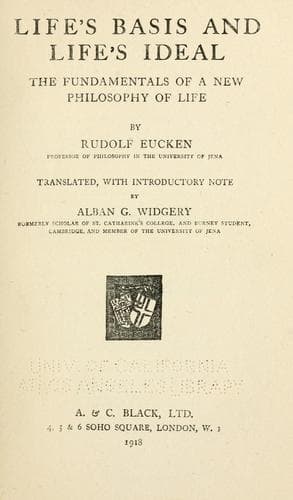
Life's Basis and Life's Ideal: The Fundamentals of a New Philosophy of LifeEucken, Rudolf
Philosophy
Life's Basis and Life's Ideal: The Fundamentals of a New Philosophy of Life
Eucken, Rudolf
Life; Ontology
creative activity was operative in the old and produced characteristic
contents, it involves something which, superior to all the change of
time, will survive convulsion and doubt, and assert itself in some way
in a more comprehensive life. But the old will not survive and re-assert
itself unless the timeless reality within it separates itself from all
human and temporary addition; unless it manifests what lies behind the
historical form.
The same thing happens in the case of the new movement that arises. With
all its greatness of achievement, limitations become manifest in it;
then, more comprehensive forms arise; and so in the historical movement
as a whole the spiritual life is revealed in forms continually
increasing in content. In opposition to the tendency for one age to be
separated from another, however, a desire for unity, for a life which in
some way embraces the multiplicity of movements and concentrations of
life, and binds them into a whole, makes itself felt. A unity can hardly
be achieved by simply regarding the different concentrations and
tendencies as on the same level and making a compromise between them;
rather it is necessary that the different concentrations and different
movements contend with one another; it is just their conflict which may
elevate and deepen life. The movement to secure this unity and to retain
elements from the past is not an accumulation of elements and tendencies
in time, but an increasing deliverance from time, the establishment of a
timeless truth independent of the change of things. Experiences, of
which the external manifestations no longer exist, are again called to
life, and preserved for all time by spiritual power; indeed, that which
is lost in immediacy by the absence of the external manifestation is
more than compensated for by an advance to the source of the power:
things which in their temporal form are a mere co-existence are
transformed into an organised whole. Movements, which in history have
often been engaged in passionate conflict, may enter into a relation of
interaction, and may be regarded as a sequence of stages, in which the
earlier prepares for the later, and the later presupposes the earlier;
in which all give life to and further one another. A universal life thus
progressively arises within the domain of man; the individual
achievements unite more and more to the building up of a new, enduring
world; the whole realises itself in the individual occurrence, and
through the development of a time-inclusive present transcends the mere
moment.
Public-domain text, read in full here on John Shaqi.
Reviews
Reviews
No reviews yet
Be the first to share your thoughts on this work.
Elsewhere in the archive
Join the Discussion
Join the discussion
Sign in to leave a comment or review.
Sign InorCreate an account