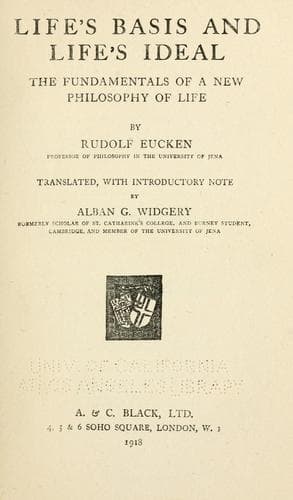
Life's Basis and Life's Ideal: The Fundamentals of a New Philosophy of LifeEucken, Rudolf
Philosophy
Life's Basis and Life's Ideal: The Fundamentals of a New Philosophy of Life
Eucken, Rudolf
Life; Ontology
In reality the experience of humanity shows such a union. Of primary
importance in this connection is the fact of the power of so-called
"ideas" in history--the fact that certain aims transcending natural
welfare win power over the whole domain of culture, bind men together
and lift them above their selfish interests. To be sure, in the
movements which arise to carry out these ideas much that is
insignificantly human is introduced; and the interests of individuals
and of classes often largely preponderate, but the origin and the
progress of these movements cannot be accounted for by the merely human;
they are only to be explained as due to man feeling directly within
himself the necessity of spiritual tasks. If he feels this necessity
only under particular conditions, and if it is only for a short time
that it asserts itself at its highest, still it extends its influence
over life as a whole, and is everywhere a unique phenomenon, even when
limited and confused by much that is alien to it.
Further, the fact that whole peoples have developed distinctive national
characters is of importance in this connection. Such a character is
distinguished essentially from all mere participation of common
conditions, not only physical but also psychical, that social life
brings with it. For the development of such a character life must rise
to energetic activity and become unified; there must be an advance
towards a common goal; an active relation must be taken up not only
towards the environment but also towards itself. A national character is
not "given," but is attained through the work of history; it develops
only through common experiences, sufferings, and triumphs: in its origin
and its continuance it involves an elevation above the aims of physical
and social preservation, a development of pure inwardness.
Finally, no inner relation of humanity proceeds from the physical
association of men, from their meeting in a common world. If a vital
whole, a common truth, did not exist within us, all our relations would
be external: we could not follow common aims in life and endeavour or
have common experiences; we could not think and live for one another, or
develop spiritual contents in different departments, such as those of
law and religion, science and art, and give to them a cognate spiritual
character. It is always the presence of a self-conscious reality that
binds humanity together inwardly. We can be as certain in our
acknowledgment of this presence as we can that our experience shows such
an inner unity in important achievements and in the formation of whole
departments of work and other complexes.
Public-domain text, read in full here on John Shaqi.
Reviews
Reviews
No reviews yet
Be the first to share your thoughts on this work.
Elsewhere in the archive
Join the Discussion
Join the discussion
Sign in to leave a comment or review.
Sign InorCreate an account