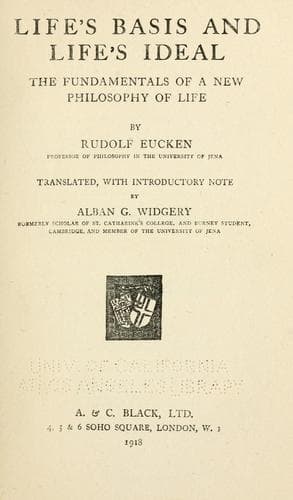
Life's Basis and Life's Ideal: The Fundamentals of a New Philosophy of LifeEucken, Rudolf
Philosophy
Life's Basis and Life's Ideal: The Fundamentals of a New Philosophy of Life
Eucken, Rudolf
Life; Ontology
With its acknowledgment we avoid the severe contradiction that is shown
in the contemporary estimate and conception of humanity. To our more
dispassionate consideration of things the disagreeable aspect of the
social machinery, the growing sharpness of the conflict, the passionate
eagerness of the desire for more, the inconsistency between the enormous
amount of subjective excitement and the spiritual poverty, are clear.
Logically, this confused and self-contradictory state of affairs ought
to lead to a rejection of the whole, and to a pronounced pessimism. Yet
humanity is regarded as noble and worthy of respect; it is made the
value of all values; the object of our faith and our hope; all our
efforts are directed towards its well-being. And this is done without it
being perceived that thus the basis of experience is forsaken and that
the impression of humanity obtained from experience is bluntly
contradicted: the introduction of an abstract conception seems to alter
everything and to lead to its being regarded as good. In the shattering
of beliefs at least this one has remained: belief in the power of
abstractions. He who would abandon this belief and at the same time hold
fast to the high estimate of humanity must admit that a spiritual world
is active in man, and in so doing acknowledge that man is more than he
appears in immediate experience. Such a one will feel increasingly the
necessity of actively comprehending and definitely distinguishing from
the medley of trivial social concerns every manifestation of a spiritual
world in man. It is not out of society but in conflict with it that
everything great has grown. And yet that which is great is rooted in a
whole of life. Spiritual work must have its basis in this invisible
whole, not in mere society; and from this position it must protest
against the presumptuous claim of society to evolve the spiritual life
of its own power. The community that proceeds from a spiritual union
will be primarily an invisible one; but whether this invisible unity
could not realise itself better and be effective also in the visible
world is a serious and difficult question that continually becomes more
urgent.
Public-domain text, read in full here on John Shaqi.
Reviews
Reviews
No reviews yet
Be the first to share your thoughts on this work.
Elsewhere in the archive
Join the Discussion
Join the discussion
Sign in to leave a comment or review.
Sign InorCreate an account