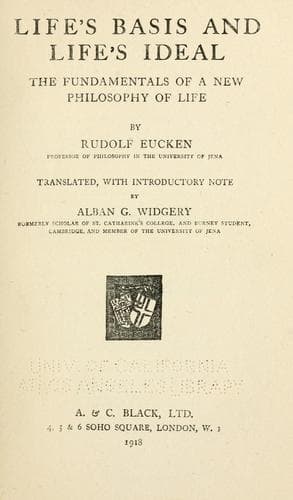
Life's Basis and Life's Ideal: The Fundamentals of a New Philosophy of LifeEucken, Rudolf
Philosophy
Life's Basis and Life's Ideal: The Fundamentals of a New Philosophy of Life
Eucken, Rudolf
Life; Ontology
At first we are occupied in work with an abundance of individual tasks
that have no inner relation to one another. But the more work advances
from an external contact with objects to an inner change of them, the
more necessary is it that these tasks should be unified so as to form a
whole; and that each task should have its position in this whole, and
represent in itself a particular aspect of the whole. The proof of
greatness in a "work" is just that the nature of the individual aspects
is determined fundamentally by their relation within the whole; that
what is characteristic in the work as a whole is manifested even in its
simplest elements; thus, for example, every independent thinker has
particular views with regard to the nature of the fundamental forms of
logical thought such as the concept and the judgment; in the same way
every independent artist creates his own language of forms. Work not
only leads to a unity of life in the case of individuals; but, further,
without a union of individual forces for a common end, without an
organisation of all human work, we should stand defenceless in face of
the infinity of the world, and we could never advance to a state of
culture. In such community of work man creates a new sphere of existence
for himself; he forms his world of work and sets it in contrast to
everything which does not come within it. This world of work transcends
the individual; and yet it is our world; it is sustained by human power
and, directing and forming, reacts upon man. For, the more unity this
world of work acquires and the more control it wins over the object, the
more definite departments and relations it evolves in itself, the more
does it manifest characteristic laws and methods which, with superior
power, prescribe to human activity its nature and direction, but which
can originate nowhere else than in the domain of man. And so within the
domain of man we rise above all caprice and subjectivity: since the law
of the object determines man's work, his life is raised above the
antithesis between soul and object. Work is not something that man,
essentially perfect, undertakes incidentally and as something
supplementary, but it is that through which he first develops a
spiritual life; through which he acquires a spiritual existence; and the
character of the work determines at the same time the nature of this
existence. As the individual departments of work evolve characteristic
modes of thought and conviction, so out of work as a whole a particular
spiritual nature arises which does not exist in relation to a world
external to it, but contains within itself a world formed by its own
activity. All this, in conformity with our fundamental conviction,
involves the implication that man is not a spiritual being from the
beginning, but only has the potency to become one.
Public-domain text, read in full here on John Shaqi.
Reviews
Reviews
No reviews yet
Be the first to share your thoughts on this work.
Elsewhere in the archive
Join the Discussion
Join the discussion
Sign in to leave a comment or review.
Sign InorCreate an account