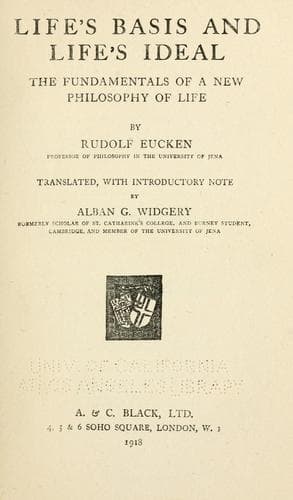
Life's Basis and Life's Ideal: The Fundamentals of a New Philosophy of LifeEucken, Rudolf
Philosophy
Life's Basis and Life's Ideal: The Fundamentals of a New Philosophy of Life
Eucken, Rudolf
Life; Ontology
Such a raising of the aim which is set to work involves an increase in
the amount of toil that it necessitates, and the dangers which are
incurred: the object and the encompassing life are subject to these
dangers. For the complete success of work and the formation of a genuine
self, it is as necessary that the object be taken up entirely into the
process of work as that there should not be another vital unity more
ultimate than the self which grows up in the work, but that the self
should form the final conclusion: whatever is not taken up into the
process of work lessens its content, weakens its power, endangers its
truth, and prevents just that from being achieved which is here in
question. If, however, we consider the opposition that arises at
different points, genuine work is seen to be a high ideal, an infinite
task which even in favourable cases is only approximately fulfilled. At
the same time it is a witness to the sway of elevating and modifying
powers within the domain of man.
The object is concealed from man chiefly by his own inclination to treat
himself as the centre of reality; to transform the environment into a
reflection of his own being; and to measure the infinite by the standard
of his own well-being. Along with this humanising of the environment,
man develops the most diverse forms of occupation with it, but however
far such occupation may be extended, it does not lead man beyond his own
domain; it does not aid him in his spiritual progress. It is possible
for occupation upon the environment to aid spiritual progress only when
things attain an independence, and from this firmly resist the tendency
of man to represent them in accordance with his subjective wishes. Only
such independence of the objective makes it possible for it to arouse
new powers in man and for his life to be based on something deeper than
immediate feeling and desire, and to begin an inner transformation. But
this movement has various levels which differ distinctly from one
another; and from the position of a higher level it is difficult to
regard the achievement at a lower one as genuine and complete work. The
Modern Age with its exact research often cannot regard the work of early
natural science as work of high value. A similar gradation is evident in
the striving for happiness; for the raising of human well-being. So long
as endeavour is directed to attaining and preserving mere subjective
states of feeling, and so long as a movement beyond this subjectivity is
not acknowledged to exist within man himself, and the requirements of
this movement are not satisfied--as is the case with Epicureanism and
Utilitarianism--endeavour, earnest as it may be, does not acquire the
character of spiritual work; it does not essentially advance life, and
therefore in the long run does not satisfy human needs. Epicureanism and
Utilitarianism with all their results inevitably become insipid and
empty to him.
Public-domain text, read in full here on John Shaqi.
Reviews
Reviews
No reviews yet
Be the first to share your thoughts on this work.
Elsewhere in the archive
Join the Discussion
Join the discussion
Sign in to leave a comment or review.
Sign InorCreate an account