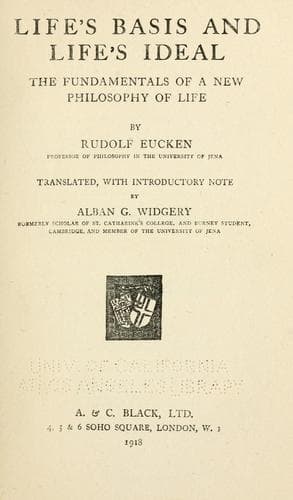
Life's Basis and Life's Ideal: The Fundamentals of a New Philosophy of LifeEucken, Rudolf
Philosophy
Life's Basis and Life's Ideal: The Fundamentals of a New Philosophy of Life
Eucken, Rudolf
Life; Ontology
It has become evident to us in many ways that from the recognition of
this a characteristic form of life proceeds. The only question is
whether the change is capable of bringing about a thorough organisation
of life, whether it can produce independent centres of life and unite
them into a community of life, and thus lead to the development of a
system of life. We ourselves most resolutely maintain the view that this
is really possible; that life is in process of forming itself into a new
whole, and that with the clearer establishment of this, problems which
have existed from early times receive full explanation, and a definite
advance is made in their solution.
We saw that, in its highest stages of development, life concentrates at
particular points, and that a characteristic sphere of life is in this
way brought forth, as, for example, in spiritual individualities,
national character, and so on. As soon as these developments are
acknowledged to be spiritual and are sufficiently distinguished from
simply natural existence, as soon as the manifestation of a new world is
recognised in them, they become a great problem. Then they cannot be
regarded as a mere product of a particular part of nature, but must be
accepted as primarily a creation from the spiritual life as a whole, a
creation which at the same time must maintain itself and transform in
its own activity that which it receives. The relation to the spiritual
world as a whole is the fundamental relation of life, and yet the
further development of life does not follow immediately from the
relation to the whole, but from the relation to the innumerable other
centres of life; the infinitude that the individual being acquires from
the relation to the whole receives that which is particular in its
organisation and its content only from the experience of the relation to
others. The relation to others, however, is not produced by nature, but
as spiritual, only from the spiritual world as a whole and must be
continually sustained by the whole. The relations of individual to
individual will therefore be included within the whole, and through the
presence of the whole will be essentially advanced beyond the capacity
of mere nature. The love that arises here is fundamentally different
from all the love which arises from natural impulse; and, understood in
this manner, notwithstanding all that may be doubtful in respect of its
fulfilment in individual matters, there is much point in the demand of
Augustine, that, in the relation of man to man, not man but God should
be set in the first place, and that man is to be loved only through God.
Public-domain text, read in full here on John Shaqi.
Reviews
Reviews
No reviews yet
Be the first to share your thoughts on this work.
Elsewhere in the archive
Join the Discussion
Join the discussion
Sign in to leave a comment or review.
Sign InorCreate an account