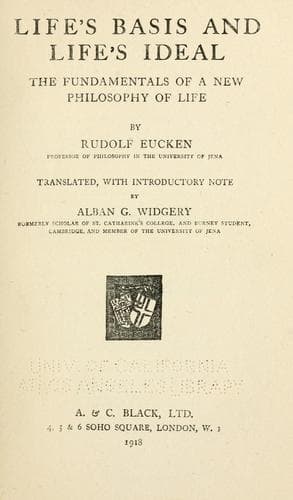
Life's Basis and Life's Ideal: The Fundamentals of a New Philosophy of LifeEucken, Rudolf
Philosophy
Life's Basis and Life's Ideal: The Fundamentals of a New Philosophy of Life
Eucken, Rudolf
Life; Ontology
primarily as means to the increase of human power, and must assume a
form corresponding to this. And so life everywhere becomes more active
and more powerful: it finds its aim within itself, in its own elevation,
and has therefore no need to seek it in something external; the whole
existence of man becomes more his own work. As work comes more deeply
into touch with the nature of things the development of power becomes at
the same time a controlling of the world. It was not to be wondered at,
therefore, when the modern man, with the development of this system of
life, believed that for the first time he had left a childlike condition
of constraint and limitation, and entered a state of freedom and
maturity.
But the further development of life shows clearly enough that this
system, which makes force and movement its leading principles, is not
the final stage of human endeavour: the leading idea of our whole
investigation is that human endeavour is more than this. We have seen
that a system of mere force and movement gives no soul to work and does
not lead life to self-consciousness and self-determination. A rushing
stream seizes us and carries us along with it, but we reach no position
independent of it; and so we cannot unify the multiplicity, nor gain a
content from its immeasurable achievement; indeed, the increasing
extension of life divides us more and more into single forces, and
deprives us of a self that transcends the movement. At first this was
not fully perceived, since the soul was implicitly assumed to be force
and the extension of movement was regarded as a pure gain to the life of
the soul. But the further development and the keener emphasis on the new
state attained could not but clearly indicate the contradiction here
involved; could not but lead to a separation between soul and work, and
force them into conflict. Hence there is a danger of work becoming
mechanical, and of the life of the soul, which, with this separation, is
thrown back entirely upon the subjective, being lost in indefiniteness.
These experiences of mechanical work and indefinite subjectivity give
birth to a new situation, in which the problem of the soul, a problem
which in the earlier systems remained in the background, is forced into
prominence. The task of life is seen to be a more fundamental one; it is
a matter not so much of altering a given reality in one way or another
as of first discovering a genuine reality, of advancing beyond all mere
activity to a being which exists within the activity.
Public-domain text, read in full here on John Shaqi.
Reviews
Reviews
No reviews yet
Be the first to share your thoughts on this work.
Elsewhere in the archive
Join the Discussion
Join the discussion
Sign in to leave a comment or review.
Sign InorCreate an account