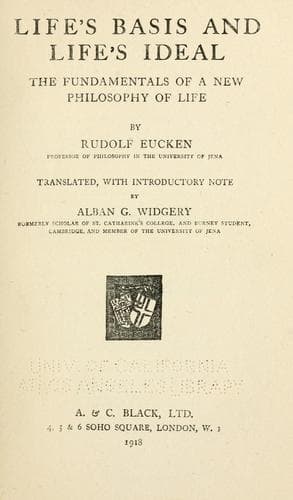
Life's Basis and Life's Ideal: The Fundamentals of a New Philosophy of LifeEucken, Rudolf
Philosophy
Life's Basis and Life's Ideal: The Fundamentals of a New Philosophy of Life
Eucken, Rudolf
Life; Ontology
II. THE MORE DETAILED FORM OF OUR SPIRITUAL LIFE
(a) THE PROBLEM OF TRUTH AND REALITY
Whatever there is peculiar in our conception of the spiritual life must
be manifested and proved in reference to the problem of truth and
reality. In the first place our conception decidedly rejects the widely
held view of truth as a correspondence of our thought with an external
reality. For the attainment of independence by the inner life makes it
impossible for something externally existing to be taken up into life
without undergoing an essential change. It is also inconceivable from
this point of view how something beyond us could in any way attract and
arouse us. The problem of truth can do this only if it originates within
our own life: it can become a compelling power only if the attainment of
truth aids us to transcend a division within ourselves which has become
intolerable. The representation of life, that we have given, makes it
quite evident that such a division does spring up within us. Within our
own life a certain activity begins, which becomes wider and wider, and
which would signify our whole being. But this activity finds limits and
contradiction within ourselves: much takes place in our experience
independent of this activity and apparently without our co-operation; a
certain condition of things exists, and asserts a rigid actuality; and,
so far as this condition extends, we are bound; we bear something
impenetrable within us. So long as these two sides of our being remain
separated life is not complete and genuine: activity lacks a foundation,
a content, and a direction that is sure of its aim; and all the bustle
of free movements, all effort of reflection cannot conceal the state of
spiritual poverty. On the other hand, the fact that we bear so much
within us that only half belongs to us and that presses upon us like a
fate must cramp and oppress us. And so life does not experience itself
as a unity; it lacks an inner truth, since activity presents itself as a
whole and yet is not one. Life itself is therefore a problem. The
problem must be felt to be the more serious the stronger the desire for
a self-consciousness becomes. However, self-consciousness cannot
possibly be reached without a transcendence of the division between
activity and the given condition of things. Life has first to seek
itself, its unity, its perfection; and it is just this that is the
problem of truth: and in this problem life is turned not towards
externals, but towards itself. We understand now how the desire for
truth can exert such an enormous power, for, in this struggle for truth,
we fight not for something alien, but for our own being.
Public-domain text, read in full here on John Shaqi.
Reviews
Reviews
No reviews yet
Be the first to share your thoughts on this work.
Elsewhere in the archive
Join the Discussion
Join the discussion
Sign in to leave a comment or review.
Sign InorCreate an account