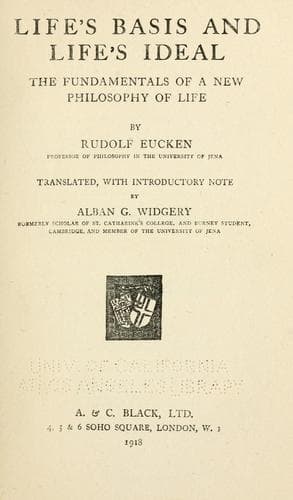
Life's Basis and Life's Ideal: The Fundamentals of a New Philosophy of LifeEucken, Rudolf
Philosophy
Life's Basis and Life's Ideal: The Fundamentals of a New Philosophy of Life
Eucken, Rudolf
Life; Ontology
This conception of truth determines also the nature of the effort to
attain truth. The task cannot be to subordinate one side of life to the
other, and to derive one side as far as possible from the other; that
is, to transform the given condition of life as far as possible into
free activity, or to adapt activity to the given condition in such a way
that activity is merged into it; but the task is one of pressing forward
to a transcendent active whole which unites the two sides, and develops
them both; and in mutual relation gives to activity a content and to the
given condition a soul. We have seen how a movement to attain such a
unity runs through history and extends into the soul of the individual.
That life is in general able to unify and raise itself is the
presupposition of all striving after truth: the proof of this, however,
is to be found in the actual furtherance of life, in the new contents
which are thus obtained.
Such a way of regarding truth, that is, as an upward endeavour of life
to its own unity, a unity not forced upon it but immanent, exhibits its
unique nature especially in its opposition to the intellectualistic
conception of truth, which, notwithstanding that it has been rejected
and attacked so often, still continues to assert a mighty power.
According to the intellectualist, cognition should treat the problem and
solve it of its own capacity; it seems that the synthesis that is sought
must be found in the first place in the realm of thought, and thence
imparted to the rest of life. As a fact, however, knowledge itself is
affected with particular severity by the division of free activity and
fixed given condition; and from its own capacity thought cannot attain
to a state of full creative activity which alone is able to overcome the
division, but for the attainment of this is referred to an advance of
life as a whole which alone can reach an essentially new position. To be
sure, cognition has particular fundamental logical principles which
regulate all its work. But to regulate and to produce are two different
things. The most scrupulous adherence to these principles does not lead
beyond reflection to an inner relation to the object, to an inner
transcendence, a penetration, and an appropriation of the object; it
leaves us still in the position of simply attempting to know, in a state
of mere reflection and search. All real knowledge involves a spiritual
creation, an advance, and a self-formation of life as a whole. The chief
epochs of culture have therefore given a distinctly unique character to
the inner nature and the fundamental texture of knowledge; the character
given to it by one epoch being entirely different from that given to it
by another. Modern knowledge does not differ from earlier knowledge only
in a quantitative way: as soon as its connection with the chief
synthesis characteristic of modern life is revealed, it can no longer be
regarded as absolute knowledge, but only as a particular kind of
Public-domain text, read in full here on John Shaqi.
Reviews
Reviews
No reviews yet
Be the first to share your thoughts on this work.
Elsewhere in the archive
Join the Discussion
Join the discussion
Sign in to leave a comment or review.
Sign InorCreate an account