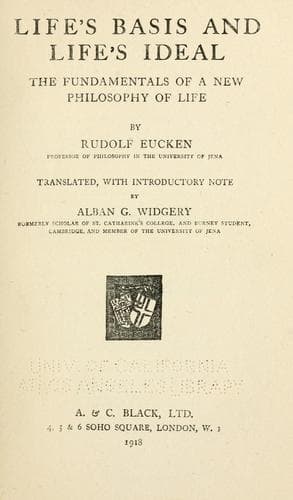
Life's Basis and Life's Ideal: The Fundamentals of a New Philosophy of LifeEucken, Rudolf
Philosophy
Life's Basis and Life's Ideal: The Fundamentals of a New Philosophy of Life
Eucken, Rudolf
Life; Ontology
Reality, therefore, is to be found chiefly in the self-consciousness of
the spiritual life; from this self-consciousness we build up our
reality. Since spiritual requirement is from this point of view the
measure of human undertaking, our activity is judged by the degree to
which the state of the world is changed in it and has thus become our
reality. How far our capacity reaches in this matter cannot be decided
by preliminary consideration, but only by the progress of life itself:
in particular it is not permissible to assume things-in-themselves
independent of us and thus to reduce our world to a realm of mere
appearances. For, so far as that independence reached, things could
never enter our life, and never be inwardly appropriated; at most they
could concern us only in their effects. As far as the conception of
nature as a mechanism is concerned, which regards all occurrence as a
texture of related individual points which exist, inaccessible, behind
it, there is much to be said for the view that things are only known in
their effects; but this view is an intolerable limitation--dogmatic in
the highest degree--if it is meant to represent our fundamental relation
to reality and to ourselves. For then we should be related to ourselves
as to something alien; all the self-consciousness of life would be
destroyed; there could be no development of being in contrast to single
acts, but we must be completely resolved in the stream of appearances;
there would be no advance in the striving after reality. As a matter of
fact, we are concerned primarily with the content that life is able to
give to itself; how far it presses forward to reality. Our world is to
be measured more especially by the degree in which life becomes
deepened. But from the beginning man, so far as he shares in the
spiritual life, is not a being adjacent to reality, but within it. He
would never be able to attain to a reality if he did not bear it within
himself and needed only to develop it. Thus ultimately he does not look
inwards from outside, but outwards from within; and his limitation is
not the chief thing, but the secondary.
Public-domain text, read in full here on John Shaqi.
Reviews
Reviews
No reviews yet
Be the first to share your thoughts on this work.
Elsewhere in the archive
Join the Discussion
Join the discussion
Sign in to leave a comment or review.
Sign InorCreate an account