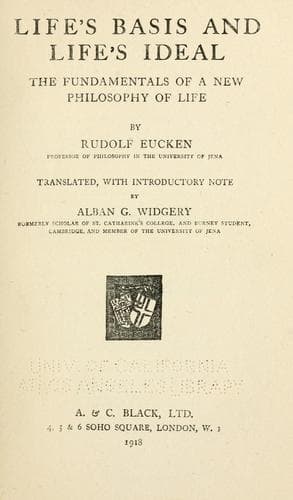
Life's Basis and Life's Ideal: The Fundamentals of a New Philosophy of LifeEucken, Rudolf
Philosophy
Life's Basis and Life's Ideal: The Fundamentals of a New Philosophy of Life
Eucken, Rudolf
Life; Ontology
nature and in accordance with the standards of that nature. The power to
convince possessed by sense impression is now based, not on its
obviousness, but on the spiritual activity that it arouses. Here also,
only the experiences of the spiritual life itself can lead to the
experience of something less than spiritual.
As such a revolution brings clearly to consciousness the spiritual
achievement in the formation of reality, so at the same time it gives
the object more movement and transforms it in spiritual endeavour. Two
things are necessary to the conception of reality: an independence of
man, and a realisation of the many as a unity. Now, since that which
lies wholly beyond experience must for that reason be inaccessible to
us, this assertion of independence can have no other meaning than that,
within life itself, something becomes detached from the stream of
consciousness and fixes and asserts itself as independent of it. The
power thus to transcend the time-process is a characteristic mark of all
spiritual activity; this activity evolves within us something in
opposition to us, and in so doing accomplishes a marvellous expansion.
This is most clearly seen within the sphere of thought. For all the
functions peculiar to thought receive their differentiating
characteristic only through such a detachment from the flow of
sense-presentation and by establishing themselves as independent of it:
the concept presents its content as something fixed in contrast to the
stream of presentations; the judgment proclaims its connection of
concepts to be something that does not pass away with the act of
connecting them but persists in face of all the changes of the psychical
life. Life accomplishes a gradation within itself and lifts itself above
the mere stream of change. Only because life establishes within itself a
fixed nucleus, and in this manner wins an independence of its own
momentary condition, can it oppose a world to itself, and set itself the
task of appropriating this world--that, further, that independent
nucleus should remain no mere collection, but should be inwardly unified
is again a requirement and an achievement of the spiritual life. How far
that requirement will be fulfilled depends upon the nature and the
degree of the development of the spiritual life.
Public-domain text, read in full here on John Shaqi.
Reviews
Reviews
No reviews yet
Be the first to share your thoughts on this work.
Elsewhere in the archive
Join the Discussion
Join the discussion
Sign in to leave a comment or review.
Sign InorCreate an account