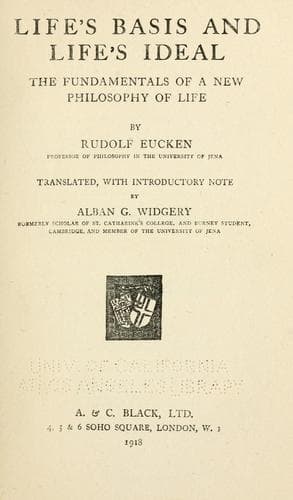
Life's Basis and Life's Ideal: The Fundamentals of a New Philosophy of LifeEucken, Rudolf
Philosophy
Life's Basis and Life's Ideal: The Fundamentals of a New Philosophy of Life
Eucken, Rudolf
Life; Ontology
The revelation of such an original fundamental activity of the spirit
must induce us to undertake to form our whole world from this activity,
and to produce from it or to transform into it that which exists over
against activity as an independent realm of experience. This has been
attempted for thousands of years with the summoning of an enormous amount
of spiritual power and the arousing of a proud self-consciousness. But
failure was inevitable because it was not recognised that the development
of the spiritual life in man is conditioned. However certain it may be
that original spiritual movements must be active within us, they are not
so with organised content and overwhelming power from the beginning, but
they acquire content and power only through the process of life itself,
only in grappling with the oppositions of experience and in the
appropriation of the tasks and stimuli which experience brings to them.
The incompleteness and the mutability of what was accepted earlier as a
fixed and unchangeable racial possession of the spiritual life is to-day
quite clearly perceived. What great changes morality, for example, has
undergone in the course of the ages; how toilsomely has much been won
which later ages have considered self-evident! To be sure, morality
remains, even through all such changes, an original spiritual phenomenon,
which can never be derived from an external source, but which could
emerge and establish itself only as an inner necessity of the spiritual
life in opposition to the realm of mere utility. But the actuality of
this original phenomenon gives rise to a difficult problem, for the
solution of which a closer contact with the environment, a fundamental
arrangement with experience, is necessary. And so the problem is traced
to a more ultimate source, and, though this makes the matter less
simple, it gives a higher significance to our work and to the movement
of history.
Even the fundamental forms of thought which are often accepted as of
everything the most fixed share in this gradual amplification. Man, so
far as he participates in spiritual impulse, thinks, of course, in
conceptions; he gives to appearances fixed points of support by the
establishing of things, and relates events causally. But all this is
full of problems and is comprehended only in its upward endeavour; it
raises more problems than it solves; and around the solution of these
the whole work of science moves. What different things the "idea" meant
to Plato and to Kant, and to ancient and to modern thought generally:
how every thinker of moment has given a particular conception of
substance and of causality; how whole epochs have exhibited their
particular nature in the treatment of these problems!
Public-domain text, read in full here on John Shaqi.
Reviews
Reviews
No reviews yet
Be the first to share your thoughts on this work.
Elsewhere in the archive
Join the Discussion
Join the discussion
Sign in to leave a comment or review.
Sign InorCreate an account