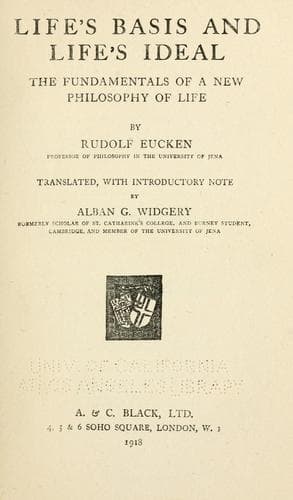
Life's Basis and Life's Ideal: The Fundamentals of a New Philosophy of LifeEucken, Rudolf
Philosophy
Life's Basis and Life's Ideal: The Fundamentals of a New Philosophy of Life
Eucken, Rudolf
Life; Ontology
The question as to in which direction the spiritual life moves in man is
implied through our whole investigation, and in it receives an answer.
Nevertheless, it requires to be definitely stated and treated by itself,
so that the distinctive character of the movement and its influence in
the moulding of life may be fully acknowledged. It has become clearly
evident to us that an independent and, therefore, genuine spiritual
life cannot arise out of life in its usual condition, but only in
opposition to this condition. For, however little this condition of life
may lack spiritual elements, they are mixed and bound up with other
elements far too much to be able to bind themselves immediately into a
whole, and to display an independent power. That the spiritual life must
and can gain a basis independent of this condition of life is the
indispensable, fundamental idea of Idealism. But such attainment of
independence of the usual condition would help little if the spiritual
life which is based upon itself had not a particular nature of its own,
and if from this it did not oppose everything alien and partly alien to
itself. The doctrines of innate ideas, of an _a priori_, and so on,
which have occupied humanity for thousands of years did not intend
anything different from this. The details of the conception of these
were indeed often open to criticism: it was sought to exhibit individual
conceptions and propositions as existing complete at the beginning,
where rather movements or tendencies are in question, which can find
their realisation only within the work of life. Again, the _a priori_
was limited to the intellectual sphere, whereas it is indispensable to
all spiritual activity; for example, how can morality, rising above
merely natural preservation and rejecting all mere utility, as it does,
be conceived without such an _a priori_? To deny to spiritual life an
original nature and power--an _a priori_ in this more comprehensive
sense--means nothing else than to eliminate that life as an independent
factor, and to reduce it to the position of a secondary product. For
without an original nature the spiritual life would be like soft wax
that may be shaped in one form or another to suit our own pleasure: then
the spiritual life could not possibly follow its own aims, could not
possibly attain to an independence in the inner life, in which we
recognised the characteristic nature of the inner life. As certain as it
is that there is a spiritual life at all, so certainly does it bring
certain fundamental tendencies and movements with it; as surely as it
develops in particular directions--and that it does this we have
seen--so surely is this _a priori_ also differentiated. To trace this
fundamental state of spiritual activity in all its relations and
multiplicity is an especially important task of philosophic research.
Public-domain text, read in full here on John Shaqi.
Reviews
Reviews
No reviews yet
Be the first to share your thoughts on this work.
Elsewhere in the archive
Join the Discussion
Join the discussion
Sign in to leave a comment or review.
Sign InorCreate an account