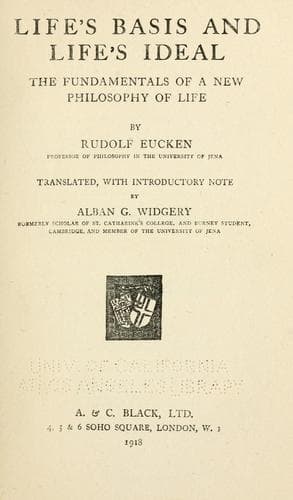
Life's Basis and Life's Ideal: The Fundamentals of a New Philosophy of LifeEucken, Rudolf
Philosophy
Life's Basis and Life's Ideal: The Fundamentals of a New Philosophy of Life
Eucken, Rudolf
Life; Ontology
The new life cannot develop without elevating the individual in his
spiritual nature above all environment. For, as surely as the
construction of a spiritual reality within humanity needs a union of all
powers, there is a spontaneous springing up of the independent spiritual
life only within the soul of the individual. All social and all
historical life that does not unceasingly draw from this source falls
irrecoverably into a state of stagnation and desolation. The individual
can never be reduced to the position of a mere member of society; of a
church, of a state; notwithstanding all external subordination he must
assert an inner superiority; each spiritual individual is more than the
whole external world. But as the individual does not derive this
superiority from himself, not from a natural particularity and
peculiarity in distinction from others, but only from the presence of a
spiritual world, so he is securely guarded from all vain self-assurance
and the arrogance of the idea of the Superman, which grotesquely
distorts the great fact of the revelation of a universal life at
individual points.
The desire for the presence of the infinite at the individual point may
be characterised as an approximation to mysticism. Indeed, we need both
a metaphysic and a mysticism; but we want both in a new form, not in the
old. It seems to us preposterous to declare that necessary demands of
the spiritual life are finally disposed of, because the older solution
has become inadequate. If man does not in some way succeed in
appropriating the spiritual life, if it is not actively present as a
whole within him and animating him, then his relation to the spiritual
life remains for ever an external one; and this life cannot acquire a
complete spontaneity in him, can never become a genuine life of his own.
But the older mysticism was the offspring of a worn-out age, which
primarily reflected upon quietness and peace, and was under the
influence of a philosophy that sought the truth in striving towards the
most comprehensive universal, and saw in all particularity a defect
(_omnis determinatio negatio_). And so, to be completely merged in the
formless infinite could be regarded as the culmination of life. As the
spiritual life is to us, on the contrary, an increasing activity and
creation, a world of self-determining activity, so its being called to
life at individual points is a rousing of life to its highest energy; in
this also, a continual appropriation is necessary. Further, the movement
of the spiritual life does not appear to us as an advance from
particular to universal, but as one from differentiation to the living
whole; from the indefiniteness of the beginnings to complete
organisation and distinctive form. The inwardness that we advocate is
not a feeble echo and a yearning for dissolution, but is of an active
and masculine nature, and rests on ceaseless self-determining activity.
Public-domain text, read in full here on John Shaqi.
Reviews
Reviews
No reviews yet
Be the first to share your thoughts on this work.
Elsewhere in the archive
Join the Discussion
Join the discussion
Sign in to leave a comment or review.
Sign InorCreate an account