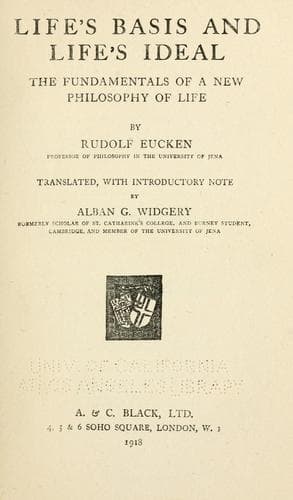
Life's Basis and Life's Ideal: The Fundamentals of a New Philosophy of LifeEucken, Rudolf
Philosophy
Life's Basis and Life's Ideal: The Fundamentals of a New Philosophy of Life
Eucken, Rudolf
Life; Ontology
One may or may not call this mysticism; in any case mysticism of such a
kind cannot be charged with that which now appears to us to be defect or
error in the older form.
(2) _The Increase of Movement_
As certainly as a universal life must surround us and, with efficient
power, in some way be implanted within us, yet only our own activity can
appropriate and amplify that life for us. As the transition to the
independent spiritual life changes the problem so that no achievement
in a given world will satisfy it, but only the winning of a new world,
our existence must become much more active; our life must be made not
only much more comprehensive but also inwardly transformed and deepened.
Naïve opinion is accustomed to presuppose a fixed sphere for our
activity; it is possible for it to do this only because it confuses the
spiritual and that which is less than the spiritual and leaves them
undifferentiated. Since the attainment of independence by the spiritual
life makes this confusion impossible, it may at the same time be
recognised that the fixed relations in which we seem to be are also in
reality due to our own activity. From this fact a method of treatment is
justified, the introduction of which constitutes one of the greatest
services of Kant. This method in his own terminology is the
transcendental method. Unlike ordinary opinion, it does not regard the
relation of the departments of life and all its activities as being
self-evident, but it enquires into the inner possibility of this
relation, that is, it indicates the conditions without which the union
of the manifold could not be accomplished; it reveals the spiritual
activity that exists in the whole. It reveals a far finer texture of
life; it shows syntheses from the whole to the elements; it indicates
clearer limits and makes us more definitely recognise what
differentiates the individual departments. This is what Kant did in the
case of scientific knowledge, of morality, and of the realm of the
beautiful. The transcendental method itself is first indisputably
justified and given a secure foundation with the acknowledgment that a
world of independent spirituality emerges in man, and this through his
own activity, not by a mere favour and gift of destiny. For, when this
independent spiritual world is acknowledged it first becomes a matter
beyond doubt that the basis, and the bonds which unite the whole, could
not be given, but must proceed from our own activity. The transcendental
method must therefore be applied not only to the individual branches but
also to the whole, and the possibility of a spiritual life in man in
general made a problem. Then from the whole the method must also be
extended to the departments that are not brought into prominence by
Kant; it must discuss, for example, the possibility of history in a
characteristically human sense. Since our reality is thus dependent in
the first place upon our own activity, life and movement acquire a wider
Public-domain text, read in full here on John Shaqi.
Reviews
Reviews
No reviews yet
Be the first to share your thoughts on this work.
Elsewhere in the archive
Join the Discussion
Join the discussion
Sign in to leave a comment or review.
Sign InorCreate an account