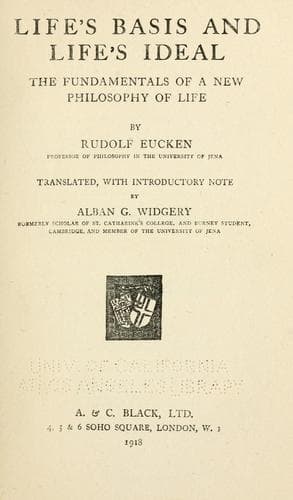
Life's Basis and Life's Ideal: The Fundamentals of a New Philosophy of LifeEucken, Rudolf
Philosophy
Life's Basis and Life's Ideal: The Fundamentals of a New Philosophy of Life
Eucken, Rudolf
Life; Ontology
Enlightenment, to the proud self-confidence of which a conscientious
self-examination forms a necessary antithesis. The critical method
reached its highest point in Kant, and we can never go back again upon
the transformation of life that has been effected by it. But how could
the critique be justified and exercise such far-reaching influence as it
has done, if it were not more than a product of a subjective reflection
that accompanies the object, and that has to do with the object
externally? The critique could effect an inner transformation and
elevation of work only because it set new forces in motion. And it did
this in that it measured all human achievement by the demands of a
transcendent spiritual life and out of it developed inner necessities,
to which all achievement had to correspond. So the movement was not lost
through the lack of an aim; and life did not flow onward with the stream
of presentations, but found a support in itself; it was able to exert a
powerful counteraction; it did not need to acknowledge anything that
had not proved its validity before the judgment-seat of immanent reason.
This emergence of the question of validity in contrast to that of
actuality must inwardly raise and ennoble the movement of life; it
reveals to man an active relation not only to the environment but
primarily to himself; it leads to a ceaseless differentiation and
examination of the quality of life.
It is true that the Enlightenment, which acknowledged that alone to be
true which was clearly and distinctly cognised, exercised this critique
in a too narrow manner; yet notwithstanding all that may be
problematical in its application to details, the right and the necessity
of the fundamental idea are not thereby overthrown: the question
remains; it can be fully justified only in the relations that we have
indicated; but at the same time it must be transferred from the merely
intellectual to the spiritual as a whole, and form in relation to the
whole that which in the state of culture contains and develops an
independent spirituality and a self-conscious life; but by this it gains
a content of truth. This self-consciousness alone can be regarded as
essence and genuine reality, while everything else is reduced to mere
environment and becomes matter of secondary importance, if not of mere
appearance. Task after task is revealed, more especially for the
present; we see how, with the attainment of independence by the
spiritual life, the movement is not only extended, but also grows
inwardly and tends towards the elevation of life.
(3) _The Gain of Stability_
Public-domain text, read in full here on John Shaqi.
Reviews
Reviews
No reviews yet
Be the first to share your thoughts on this work.
Elsewhere in the archive
Join the Discussion
Join the discussion
Sign in to leave a comment or review.
Sign InorCreate an account