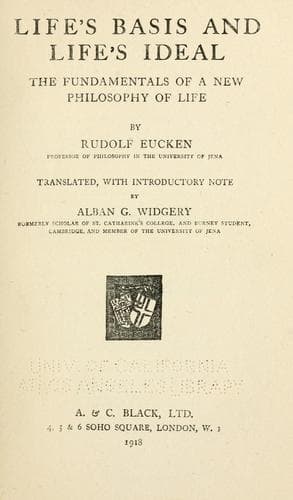
Life's Basis and Life's Ideal: The Fundamentals of a New Philosophy of LifeEucken, Rudolf
Philosophy
Life's Basis and Life's Ideal: The Fundamentals of a New Philosophy of Life
Eucken, Rudolf
Life; Ontology
scope and a greater value.
The movement of life also tends to be increased by the fact that in our
conviction the more detailed form of the spiritual life itself must
first be won by our activity, and that this detail can be acquired only
little by little through attempts, experiences, convulsions; that for
man the spiritual life with its actuality forms a difficult problem.
What more particularly separates us from the Enlightenment is that while
for it the ultimately valid form of the spiritual life appeared to be
immediately present and to need only an energetic working out, we extend
the historical treatment not only to the representation, but also to the
nature, of the spiritual life; and so the ultimately valid form of the
spiritual life appears to be a high ideal, to which man can only
gradually approximate. The fact that endeavour is centred not upon
externals but primarily upon our own being must make our activity far
more significant and more intense; and this leads to a higher estimate
of history as well as of a historical treatment. As hence epochs are no
longer distinguished simply by their achievements, but by the nature of
their spiritual life, so the life of the present must also be given its
place in the moving stream, and so our innermost nature also depends on
spiritual work.
If with such an increase of movement much is mutable that otherwise
seemed to be as firm as a rock; and if, in particular, the foundations
of life themselves also suffer change, life seems to lose all support
and to fall into an unlimited relativism. Indeed, life must thus lose
all stability if in the spiritual sphere movement does not involve
something in opposition to change: and this as a fact it does involve.
As the spiritual life cannot develop a content without presenting it as
timeless, there is no great achievement in history that does not include
some kind of timeless truth, and the movement of the spiritual life is
not merely a flowing onward with time but also an elevation above time.
In spiritual work, therefore, the achievements of the ages can be
surveyed and examined; indeed, in distinguishing between past and not
past the sequence of times can be transformed into a timeless present.
Of course this is valid only with the presupposition of an absolute
spiritual life, which is present in all the uncertainty and change of
human undertaking, and does not allow it to become fixed in error.
Unless an immanence of the absolute spiritual life is acknowledged, an
essential characteristic of the spiritual work of the Modern Age remains
absolutely unintelligible, namely, its critical character. Modern work
is not completely objective, and occupation with the object does not
completely exhaust that work; but activity realises its independence of
the object, investigates its relation to the object, surveys that which
has been achieved, and tests it by transcendent standards. Such a
critique belongs especially to the fundamental nature of the
Public-domain text, read in full here on John Shaqi.
Reviews
Reviews
No reviews yet
Be the first to share your thoughts on this work.
Elsewhere in the archive
Join the Discussion
Join the discussion
Sign in to leave a comment or review.
Sign InorCreate an account