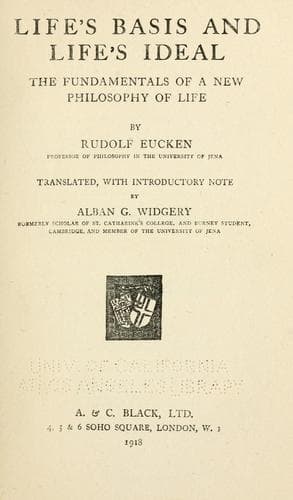
Life's Basis and Life's Ideal: The Fundamentals of a New Philosophy of LifeEucken, Rudolf
Philosophy
Life's Basis and Life's Ideal: The Fundamentals of a New Philosophy of Life
Eucken, Rudolf
Life; Ontology
The system of life here developed receives its distinctive colour and
tone chiefly because it brings into prominence the fact that we do not
belong to a world of reason, which from the beginning had only to be
perceived and enjoyed, but that we have first to advance to such a
world; and for this we require a revolution of the first condition of
things. The basis of true life must continually be won anew; and even
the individual achievement always contains a decision between one and
another type of life. Only through ceaseless activity can life remain at
the height to which it has attained; that which life experiences and
receives is judged according to the more precise form of activity. Since
it gives this precedence to activity, to such activity, this system may
be called "Activism." Activism, however, demonstrates its unique
character and develops its capacity only if it is definitely
distinguished from all other apparently related tendencies. Neither a
sudden resolution nor even a mere incitement of power brings us at once
into the condition of activity. For at first we are surrounded and
embraced by a world of inflexible nature and of feeble spirituality,
which is at the same time mixed with human pretence: this world binds us
so strongly, and suppresses all independence with such force, that the
mere individual remains entirely powerless in opposition to it, and
could soar to no higher wisdom than that of an involuntary submission to
it. Activity without release from the given world is an absurdity; but
such release is attainable only through the living presence of a world
of self-determining activity; the power of such a world alone is able to
arouse the individual to self-determining activity. But how could man
appropriate this world to himself without changing its life into his
own; without acknowledging its content as valid for himself also;
without making its laws norms of his conduct?
Public-domain text, read in full here on John Shaqi.
Reviews
Reviews
No reviews yet
Be the first to share your thoughts on this work.
Elsewhere in the archive
Join the Discussion
Join the discussion
Sign in to leave a comment or review.
Sign InorCreate an account