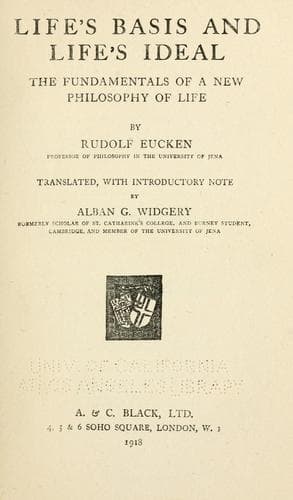
Life's Basis and Life's Ideal: The Fundamentals of a New Philosophy of LifeEucken, Rudolf
Philosophy
Life's Basis and Life's Ideal: The Fundamentals of a New Philosophy of Life
Eucken, Rudolf
Life; Ontology
Activity in this way acquires an ethical character; it is this which
draws the boundary line between spiritual activity and merely natural
impulse, and distinguishes genuine from imaginary self-determining
activity. Ethical relation does not mean a submission to alien and
unsympathetic regulations, but a taking up of the infinite spiritual
world into our own volition and being: this relation brings things close
to us and reveals them, so that they are able to impart their life to
us, and we are able to grow with their growth. So understood, ethical
relation is primarily not regulative but productive; it is not merely
being prepared to fulfil certain demands, when they are made upon us, to
live in accordance with strict regulations, but it involves the motive
of aiding in the development of the world, of advancing everything good
and true: it requires an untiring forward endeavour and advance to the
building up of a kingdom of reason and love. If in this way conduct is
lifted above the pursuit of that which pleases and interests the mere
subject, this is not on behalf of something alien, but for the elevation
of our own being, for the sake of this genuine being, for the sake of
our spiritual self.
It is this inner elevation and this demand for a new world that
distinguishes Activism from all mere Voluntarism and Pragmatism, to
which it appears to approximate, and with which, in its negative aspect,
it is, indeed, associated. For it shares with them the rejection of an
intellectualistic view of life, in which cognition is regarded as
finding truth of its own power and as conveying it to the rest of life.
Further, Activism desires, as do Voluntarism and Pragmatism also, the
basing of truth upon a more spontaneous and essential activity. But the
flight to the will is more a reaction against Intellectualism than an
overcoming of the difficulty. As such the will does not yield a new
world and a transcendent power; it may, therefore, be that mere volition
is implicitly transformed into a self-determining activity encompassing
the whole extent of life. Pragmatism, also, which has recently made so
much headway among English-speaking peoples and beyond them, is more
inclined to shape the world and life in accordance with human condition
and needs than to invest spiritual activity with an independence in
relation to these, and apply its standards to the testing and sifting of
the whole content of human life. But after the experiences of history
the claim to this latter can scarcely be given up. After man has been
seen to be particular and limited in nature, as things first present
themselves, he no longer suffices for the starting-point of the
endeavour for truth, but to attain to this starting-point an elevation
above the human into a universal spiritual life is necessary. And that
is the intention of Activism.
Public-domain text, read in full here on John Shaqi.
Reviews
Reviews
No reviews yet
Be the first to share your thoughts on this work.
Elsewhere in the archive
Join the Discussion
Join the discussion
Sign in to leave a comment or review.
Sign InorCreate an account