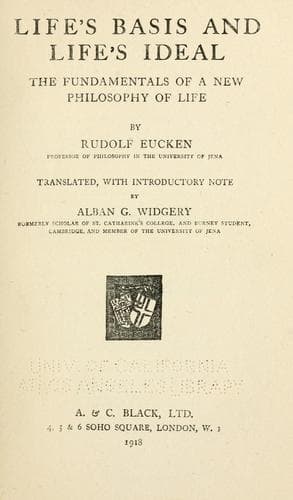
Life's Basis and Life's Ideal: The Fundamentals of a New Philosophy of LifeEucken, Rudolf
Philosophy
Life's Basis and Life's Ideal: The Fundamentals of a New Philosophy of Life
Eucken, Rudolf
Life; Ontology
The unique character of Activism becomes clearer especially in
comparison with organisations of life, of which one indeed makes
activity the chief thing, but gives to it the character of a mere
process; while another thinks of the fundamental relation of man to
reality in general not under the ideas of conduct and progress but under
those of contemplation and enjoyment. The idea that life constitutes a
process transcending all human endeavour and decision has shown a strong
power of attraction in the Modern Age; and, in the system of Hegel
especially, has found an imposing embodiment. This idea is asserted most
definitely in the evolutionary conception of history, since it regards
the motive power of history as striving to its aim, certain of
accomplishing it, and unaffected by human opinion and preference. By
this deliverance from the insignificance of human motives and the
variations of human conditions the object seemed to gain incomparably in
greatness; but it was considered that this deliverance from man involved
an elevation above the ethical conception, which then appeared to be
something subjectively human. But not only does this conception of a
process that ceaselessly advances with compelling necessity contradict
the actual state of things as they are found in history, which shows so
much stagnation and retrogression, and so many different spheres of
culture existing side by side indifferent to one another, but the
transformation of life into a mere process, if consistently carried out,
must also destroy or seriously debase its spiritual character. If life
were a mere process it would be nothing other than a soulless
mechanism; only in the case of such a mechanism can one phase proceed
immediately from the others without at the same time a whole of life
becoming active and exercising an animating power within the whole
process. As a fact, the process is usually supplemented in thought by a
universal life unifying, sustaining, and controlling the individual
phases; however, so far as such a life does not simply come to us, but
needs our own activity, the deed comes before the process; and a new
world reveals itself to us. The disregard of the ethical element by the
systems which make mere process their fundamental idea is explained by
the fact that they understand the ethical only as a decision and turning
of man, accompanying the spiritual life, not as the motive and
progressive power of the spiritual life itself. They know only a human
ethic, not an ethic of the spiritual life--as a self-assertion and a
self-elevation, through which it first attains its complete freedom and
independence. Still, to trace this further is the less necessary since
this mode of thought lives rather from earlier achievements than works
from fresh impulse springing up in the present.
Public-domain text, read in full here on John Shaqi.
Reviews
Reviews
No reviews yet
Be the first to share your thoughts on this work.
Elsewhere in the archive
Join the Discussion
Join the discussion
Sign in to leave a comment or review.
Sign InorCreate an account