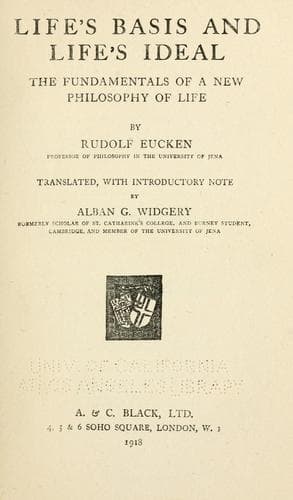
Life's Basis and Life's Ideal: The Fundamentals of a New Philosophy of LifeEucken, Rudolf
Philosophy
Life's Basis and Life's Ideal: The Fundamentals of a New Philosophy of Life
Eucken, Rudolf
Life; Ontology
Activism does not imply that immediately and at one stroke our life may
be transformed into spiritual activity and may quickly establish a
positive relation to reality: that would be to fail to recognise the
conditions under which man exists, and the necessity of undergoing
experiences and changes. Such an attitude might easily lead to the
formation of syntheses of life that would be much too hasty and far too
narrow; and the necessary breaking up of these would arouse a keen
distrust of the whole undertaking. The power which the Romantic movement
from time to time wins over minds is based on the fact that it warns us
against an over-estimation of our activity; that it demands that the
soul should be open to the influences of the world; that its
impressions should be appropriated without restriction and permitted to
fade away completely; that in opposition to all the limitation and
organisation of life, it still longs for the infinite; and that it also
to some extent satisfies by turning to unrestrained feeling. At the same
time, the Romantic movement makes us clearly conscious of the power of
destiny, the transcendence of external and internal necessities above
all human intention and utilitarian conduct. In this way life acquires a
much greater comprehensiveness and freshness; it seems to return to its
source, to retain far more immediacy. But it is one thing to acknowledge
the importance of this, another to make it the essence of life. When
such precedence is given to this Romantic tendency life threatens to
become delicate, feeble, effeminate; it knows no energetic opposition to
the flow of presentations; instead of a definite union it offers
aphoristic thoughts and stimuli; through the lack of logical acuteness
it falls into the direst contradictions; it sacrifices all distinct form
and organisation to a revelling in vague moods. As in such a state of
weakness the spiritual life does not succeed in gaining complete
independence in face of the natural conditions of our existence, so it
does not attain the necessary ascendancy over sense. Sense, in its own
province entirely incontestable, raises doubts in us in that it flows
together with the spiritual, is undifferentiated from it, brings it
under itself, and turns it from its course. And, in this, sense does not
possess the naïve freshness and the natural limitation of its original
state, but it is over-refined and too full of excitement.
Public-domain text, read in full here on John Shaqi.
Reviews
Reviews
No reviews yet
Be the first to share your thoughts on this work.
Elsewhere in the archive
Join the Discussion
Join the discussion
Sign in to leave a comment or review.
Sign InorCreate an account