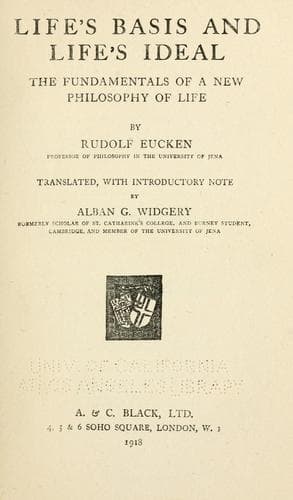
Life's Basis and Life's Ideal: The Fundamentals of a New Philosophy of LifeEucken, Rudolf
Philosophy
Life's Basis and Life's Ideal: The Fundamentals of a New Philosophy of Life
Eucken, Rudolf
Life; Ontology
To recognise all this clearly is at the same time to acknowledge the
superiority of Activism over all mere Romanticism. However much may
still be lacking in Activism, through the fact that man often regards
the difficult and complicated task as easy and simple, and thus sets too
low an estimate upon the distance between himself and the spiritual
world, there is still the objective necessity of the requirement to
transform our life as far as possible into a state of independence, to
achieve independence in opposition to a world confused and only half
rational. Such a self-determining activity is by no means simply a
matter of subjective disposition; it requires a particular form of life.
In opposition to the desultoriness and change of the life of sense it
needs a powerful unification and organisation. It advances to methods
and laws of the object in contrast to playful caprice; to a logic of the
object in opposition to a persistence in contradiction; to a further
construction of the first impression in contrast to comfortable
complacency; to a courageous continuation and building up of life in
opposition to a complacent acceptance of destiny. It gives to life a
dramatic character in contrast to a lyrical, sentimental one, and along
with this it can acknowledge fully that a genuine drama usually contains
much that is lyrical.
It is detrimental to Activism itself if it takes the problem of life
lightly. It is vital that it should not forget or underestimate the fact
that the effort to solve the problems of life meets with great
difficulties, that the solution costs incalculable trouble and work, and
that even when the best is achieved it is only approximate. When
Activism recognises this fact it may acknowledge a certain validity in
the positions of its opponents and may learn from them. But there is a
harsh contradiction that extends to the innermost basis of life, an
implacable "either--or," whether man simply receives the world and
accompanies it with his own mood, or whether he finds courage and power
to take up a conflict against confusion and irrationality, to co-operate
in the building up of a kingdom of reason. For the latter, the
affirmation of reason in the innermost basis of reality as a whole and
of his own being is necessary. Whether men and times find a way to such
an inner establishment, to such transcendence of all external and
internal limitation, is that which decides the main tendency of their
life.
III. THE SPIRITUAL LIFE IN MAN IN CONFLICT AND IN VICTORY
We intend to make the following section as short as possible, as we have
treated this subject so much in detail in "The Truth of Religion" and
also in "The Struggle for a Concrete Spiritual Experience." We must
refer those who wish for a closer consideration of the subject to those
works: the subject will be treated of here only so far as is necessary
for a representation of life as a whole; a concise statement may have
distinct advantages.
Public-domain text, read in full here on John Shaqi.
Reviews
Reviews
No reviews yet
Be the first to share your thoughts on this work.
Elsewhere in the archive
Join the Discussion
Join the discussion
Sign in to leave a comment or review.
Sign InorCreate an account