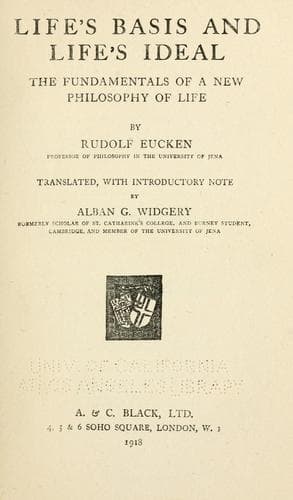
Life's Basis and Life's Ideal: The Fundamentals of a New Philosophy of LifeEucken, Rudolf
Philosophy
Life's Basis and Life's Ideal: The Fundamentals of a New Philosophy of Life
Eucken, Rudolf
Life; Ontology
That, however, is what really happens: it is the case in the relation of
the spiritual life to nature, as well as in its relation to humanity; it
happens, therefore, in our whole experience. If the spiritual life
constitutes the fundamental nature of reality; if, in it, reality first
attains to self-consciousness, it is to be expected that when the
spiritual life appeared it would create for itself an independent form
of existence in contrast to that of nature, and would exercise a
superior power in this form of existence, to which nature must
accommodate itself. But, as a fact, this is so far from being the case
that even the attempt to imagine the spiritual in any way leads
immediately to the quixotic. In the experience of humanity the spiritual
life is related in its entirety to a natural basis; in no way does it
seem able to free itself from this, but in all its activity it remains
dependent upon nature. If nature simply follows its own tendencies; if,
indifferent to value and lack of value, without aim and ideal, nature
lives its life of soulless movement, union with an order so alien and
impenetrable must most seriously affect the spiritual life. The world
goes on its course unconcerned with the weal or the woe, the persistence
or the disappearance of spiritual being, of spiritual relations, indeed
of spiritual life in general. Not only do great catastrophes, as in
earthquakes, storms, and floods, show how indifferent the existence or
the non-existence of spiritual life is to the forces of nature, but the
commonplaces of everyday experience and of individual destiny also show
the same indifference. In nature we find no difference of treatment in
accordance with any distinction of good and evil, great and mean, noble
and vulgar. Even the most eminent personality, who may be almost
indispensable to our spiritual welfare, is subject to the same
contingency, the same fate as all others. Regarded from the point of
view of the world of sense, all spiritual life is a chaotic confusion of
fleeting appearances, all of which are dependent; it is not an
independent world, but a subsidiary addition to a world which is other
than spiritual.
Public-domain text, read in full here on John Shaqi.
Reviews
Reviews
No reviews yet
Be the first to share your thoughts on this work.
Elsewhere in the archive
Join the Discussion
Join the discussion
Sign in to leave a comment or review.
Sign InorCreate an account