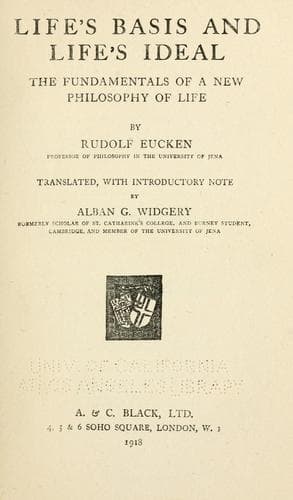
Life's Basis and Life's Ideal: The Fundamentals of a New Philosophy of LifeEucken, Rudolf
Philosophy
Life's Basis and Life's Ideal: The Fundamentals of a New Philosophy of Life
Eucken, Rudolf
Life; Ontology
Experience of the impotence of the spiritual life in relation to nature
has been the cause of mental disquiet from early times. But this
experience was not necessarily oppressive so long as mankind was called
upon to transform nature into a realm of reason, and so long as there
was hope of accomplishing this. For the contrast with the cold and rigid
external world has deepened the inwardness of human relationship and
made us conscious of the dignity and greatness of spiritual creation. In
culture, humanity has formed a characteristic sphere of life, and in
doing this has aided the spiritual life to attain a certain reality. In
culture, spiritual factors and values win power; and a new order of life
in contrast to that of nature is evolved. It cannot be doubted that a
new reality makes its appearance; but it is an open question whether
this new reality fulfils the hopes which have been placed upon it; and,
further, whether perplexities and confusions, which make it doubtful
whether anything has been gained, do not arise out of its further
development. This question is certainly not answered lightly in the
affirmative by the conviction that regards the spiritual life as a
turning of reality towards its own truth, which therefore in its
development must insist primarily on complete spontaneity and
independence. For, if in culture the spiritual life attains an
independence over against nature, it is at the same time drawn so deeply
into the particularity and limitation of human life, and is associated
so much with the merely human, that culture as a whole is anything but
the unfolding of a realm of pure, or even of only preponderating,
spirituality.
In the first place, the spiritual life does not introduce a definite and
fixed content into our experience, and it does not follow paths
independent of human striving and error; but arises through hard toil
and only slowly finds any unity: in its further endeavour it by no means
follows the same tendency, but effects great changes, indeed
revolutions, into states the exact opposite of its previous states. When
it is so uncertain as to its own aim the spiritual life becomes
seriously involved in the seeking and vacillation, in the needs and
passions, of man: instead of giving to man an immovable support and
pointing out a definite aim for his activity, it seems itself unable to
pass beyond a state of uncertain groping and error.
Public-domain text, read in full here on John Shaqi.
Reviews
Reviews
No reviews yet
Be the first to share your thoughts on this work.
Elsewhere in the archive
Join the Discussion
Join the discussion
Sign in to leave a comment or review.
Sign InorCreate an account