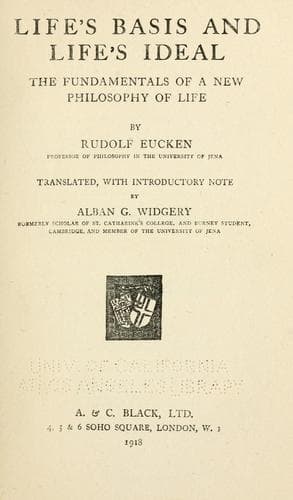
Life's Basis and Life's Ideal: The Fundamentals of a New Philosophy of LifeEucken, Rudolf
Philosophy
Life's Basis and Life's Ideal: The Fundamentals of a New Philosophy of Life
Eucken, Rudolf
Life; Ontology
The state of life, uncertain of its aims and inadequate in its means, is
rather a paltry substitute for a realm of reason than such a realm
itself. A noisy and self-conscious agitation, much unrest and
excitement, but little substance and soul; a ceaseless anxiety
concerning the means of life and hurried pursuit of them, and in the
occupation with the means forgetfulness and neglect of life itself; much
self-glorification and ostentation, and little reverence for the
spiritual life--such is social life in general. Where the vanity,
emptiness, and falsehood of the social machinery have come to be clearly
perceived, man has become absolutely wearied and satiated, and has often
fled from society to nature, to seek therein simple truth and enduring
peace. But he could believe it possible to find such in nature only
because he read this truth and peace into it from himself; as,
nevertheless, he must ultimately return to those of the same nature as
himself: thus he remains in a state of vacillation between nature, which
is indifferent to the spiritual life, and humanity, which corrupts the
spiritual life by drawing it down to the level of the narrowly human. If
the spiritual life nowhere attains to pure unfolding and certain effect
within our experience, how can the spiritual life be accepted by us in
this experience as the essence of reality? In the midst of such doubt,
the original suspicions, which may have receded before the hope of the
emergence of a new world, also become felt again--the insignificance of
the external manifestation of the spiritual life in contrast with the
immeasurableness of nature; the late appearance of the spiritual life in
the world-process, and its probable disappearance as a result of the
expected changes in the conditions of nature. Does not everything tend
to give us the impression that the spiritual life signifies no more than
an episode in the world-process; an episode which passes fleetingly, and
does not affect the fundamental nature of reality at all? The necessity
of such a conclusion remains concealed so long as man, in an undeveloped
state of life, is able to fill the world with forms similar to himself,
and to understand the control of nature on an analogy with human
conduct. But the progress of culture and especially the growth of
scientific knowledge have, with irresistible power, taken us beyond that
state; have led us from dream and illusion to a state of complete
alertness. Has not all independence of the spiritual life become
doubtful with this progress of culture and scientific knowledge, and
must we not give up all claim to subject our existence to its
sovereignty, and to determine our life and effort spiritually? For there
cannot be any doubt that, with the spiritual life, the characteristic
organisation of our existence also falls. It may be that we have thought
superficially and confusedly enough to declare something to be in itself
Public-domain text, read in full here on John Shaqi.
Reviews
Reviews
No reviews yet
Be the first to share your thoughts on this work.
Elsewhere in the archive
Join the Discussion
Join the discussion
Sign in to leave a comment or review.
Sign InorCreate an account