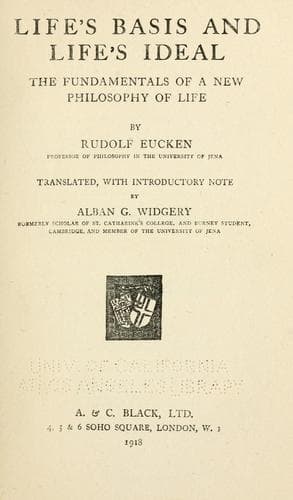
Life's Basis and Life's Ideal: The Fundamentals of a New Philosophy of LifeEucken, Rudolf
Philosophy
Life's Basis and Life's Ideal: The Fundamentals of a New Philosophy of Life
Eucken, Rudolf
Life; Ontology
falsehood and deceit, and at the same time to give to it the guidance of
our life.
(b) CONSIDERATION AND DEMAND
The previous train of thought may appear to be a plain and
straightforward negation, a complete renunciation of the spiritual life
as the most adequate solution of our problem. But that train of thought
is itself the result of a superficial treatment; every deeper
consideration inevitably contradicts such a summary procedure. A
contradiction of that train of thought is found especially in the fact
which governs the whole course of our investigation, that with the
transition to the spiritual life there appear essentially new magnitudes
and values, new forms and contents of life, which advance beyond not
only the nature but also the capacity of mere man. Whence all these, if
spiritual life is only delusion? The new in us may be never so
powerless; still, the fact that it emerges in our world of thought and
hovers before us as a possibility proves that it has a certain reality
also within us.
Further, is the spiritual life, ultimately, in every sense so powerless
as it at first appears? That it does not pass by as a phantom among our
presentations is shown by the fact that we do not simply receive the
existing condition of things, and its degrading oppression of the
spiritual life, but we feel it to be a cause of harm and of pain to us.
Could we experience this if we belonged entirely to that condition of
things; and is not Hegel right when he says that he who feels a
limitation is already in some way above it? We feel the insufficiency,
the feebleness, the threadbareness of all human morality; could we feel
this if we did not experience a longing for a more genuine morality? And
whence arises this longing in opposition to an entirely different world,
if not from a spirituality implanted within our own being? We perceive
the limitations in our knowledge; a growing insight into all its
conditions and oppositions may lead us in this matter almost to complete
scepticism: but whence came the desire for an inner elucidation of
reality; and how did even the idea of it originate, if we belong
entirely to the darkness of a nature that is less than spiritual, and if
there is no fight at all within us? We feel that the rapid flow of time,
its change and course, its sudden revolutions sometimes even into the
complete opposite of the previous state, is a defect, a source of
serious danger to truth: could we feel this to be so if our whole being
were centred in the passing moment; if we did not survey and compare the
different times; if our being did not participate in something
super-temporal? And lastly, if the feeling that culture is inadequate
and indeed nothing but a pretence is so strong and so painful, then here
again we set ourselves in a position independent of the condition of
things, and judge that condition by a transcendent standard which only
our own being can supply. If all these aims were only invented by man
Public-domain text, read in full here on John Shaqi.
Reviews
Reviews
No reviews yet
Be the first to share your thoughts on this work.
Elsewhere in the archive
Join the Discussion
Join the discussion
Sign in to leave a comment or review.
Sign InorCreate an account