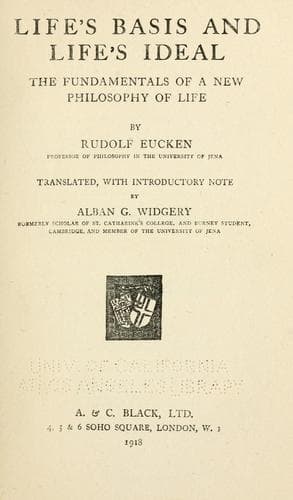
Life's Basis and Life's Ideal: The Fundamentals of a New Philosophy of LifeEucken, Rudolf
Philosophy
Life's Basis and Life's Ideal: The Fundamentals of a New Philosophy of Life
Eucken, Rudolf
Life; Ontology
and applied to life in an external manner, failure to realise them could
not agitate us as it does.
Besides, the matter is not by any means at an end with the feeling of
the inadequacy of our position; a movement in opposition to this
condition is also not lacking. For, as has been seen throughout our
whole treatment, spiritual operation, creative activity is to be found
within human experience. It meets us with especial clearness at the
heights of the work of history; but these also belong to humanity as a
whole, and the light kindled there is not entirely lost in the mist of
the commonplace circumstances of every day. In relation with these
heights of endeavour there is, in humanity as a whole, a movement in
opposition to the tendency of mediocre culture to fill life entirely; a
longing for a more spontaneous, a purer, and a more genuine life. Our
own power of creation may be dormant; only the advent of a strong
suggestion, or a serious convulsion, is necessary and it breaks forth
forcefully, and shows distinctly that there is more spirituality in man
than the circumstances of every day allow us to perceive. The spiritual
movement manifests itself also in private life and in the relation of
individual to individual. He who does not measure spiritual greatness by
physical standards will often find more genuine greatness in the
simplicity of these relations than in the famous deeds of history; and
at the same time he will find that through these relations an effective
presence of the spiritual life within human experience is strengthened.
If in its opposition to human perversion of it genuine spiritual life
does not always reach a definite positive result, the operation of that
life as the law and the judge of human things is all the more distinct.
Man may try to withdraw himself from the spiritual life; he may reject
and mock at that which the age presents to him as an aim; he may seek to
fill his life completely with human interests and inclinations: but he
cannot do this without degenerating into a state of destitution, which
even he himself soon finds to be intolerable, and without being forced,
with the compulsion of necessity, to surrender much which it is
impossible for him to surrender. The catastrophes of history in which
that which has been found insignificant sinks, and that which carries a
spiritual necessity within it rises, careless, as it seems, of the weal
or the woe of man, show in letters of brass that the spiritual life may
not be modified by man at his pleasure, in this way or that, in
accordance with his circumstances and his mood.
Public-domain text, read in full here on John Shaqi.
Reviews
Reviews
No reviews yet
Be the first to share your thoughts on this work.
Elsewhere in the archive
Join the Discussion
Join the discussion
Sign in to leave a comment or review.
Sign InorCreate an account