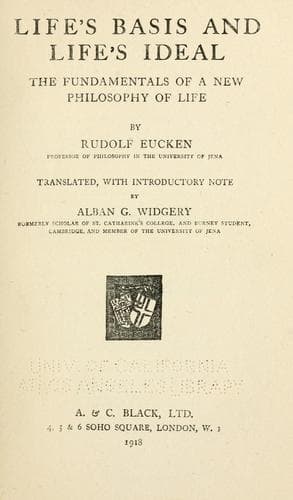
Life's Basis and Life's Ideal: The Fundamentals of a New Philosophy of LifeEucken, Rudolf
Philosophy
Life's Basis and Life's Ideal: The Fundamentals of a New Philosophy of Life
Eucken, Rudolf
Life; Ontology
But it is one thing to acknowledge such a thesis to be necessary,
another to give it the power to convince and impress, without which it
does not leave the realm of phantoms, and does not become a living
power. This is possible only where the spiritual life is taken up as our
own life, and developed as our own life; where, therefore, its
vindication attains to the overwhelming power and the axiomatic
certainty of self-preservation. The centre of reality will be changed
for us only if we change the centre of our own life, and find true
immediacy no longer in sense impression, but in self-determining
activity.
The acknowledgment of a self-conscious inwardness, of a
world-transcendent spirituality, together with the recognition of
another kind of world, full of oppositions, must give a characteristic
form to our conception of our reality. Here, a rational solution of the
world-problem is for ever excluded, and the world present to man must be
accepted as a particular kind of reality, which cannot be regarded as
the only and ultimate one. From this point of view the whole life of
humanity must appear to be a mere link in a great chain; an act of a
drama, the course of which we are unable to survey; the fundamental idea
of which, however, glimmers through sufficiently clearly to point out a
direction to our life.
Through the emergence of a world-transcendent inwardness there appear
characteristic tasks and complications, also for the more detailed
development of our life. Unqualified esteem for that inwardness has
often led religions to demand that life should be placed solely and
entirely in that transcendent sphere, in the realm of faith and of
disposition, and to free life as far as possible from the work of the
world; the former life seemed to excel the latter as the divine the
human. But this comparison does not hold good; for the divine is to us
not only a world-transcendent sovereignty but also a world-pervading
power: to honour the former preponderatingly may be the only salvation
for times and individuals in a state of prostration and collapse, and in
this way life would be given a preponderatingly religious character; but
this form of life can never be accepted as the normal one and the one
alone worth striving for. For one thing, that transcendent world, as far
as its contents and tasks are concerned, is presented to us only in
outline; all its more detailed nature must result from the world of our
activity, and must retain a symbolic character. If the connection of the
spiritual world with the empirical world is broken it falls into the
danger of becoming destitute; so that religion may come to be simply a
revelling in feeling; or a devotion, indifferent to all content and
which, therefore, judged by spiritual standards, is worthless. It is by
hard work alone, in relation to men and things, that our life acquires a
spiritual character. Religion does, indeed, elevate life above work, and
give to life its full depth.
Public-domain text, read in full here on John Shaqi.
Reviews
Reviews
No reviews yet
Be the first to share your thoughts on this work.
Elsewhere in the archive
Join the Discussion
Join the discussion
Sign in to leave a comment or review.
Sign InorCreate an account