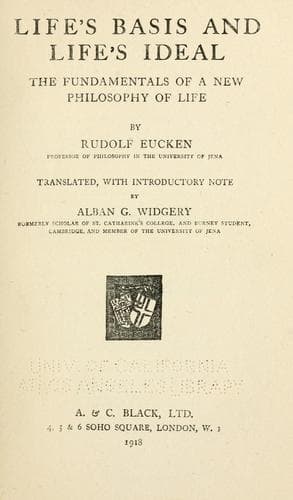
Life's Basis and Life's Ideal: The Fundamentals of a New Philosophy of LifeEucken, Rudolf
Philosophy
Life's Basis and Life's Ideal: The Fundamentals of a New Philosophy of Life
Eucken, Rudolf
Life; Ontology
Still, movement and differentiation must be
included within a vital whole; and the relation to activity which is the
chief factor in life cannot be given up even at its greatest depth. The
high estimate of spirituality may not rightly lead to a mean estimate of
nature, to a conflict with nature such as has been the case in the realm
of religion in the tendency to asceticism. For as certainly as our
acknowledgment of an independent spirituality involves a subordination
of nature, this subordination does not imply a mean estimate, still less
a rejection. Asceticism which appears to be the attainment of a high
level of spiritual life soon leads to an inward degeneration. For in
asceticism the chief task is not the powerful development and courageous
advance of spirituality, but simply a negation and suppression of sense.
Reflection and thought will thus be centred upon just those things
beyond which the spiritual movement wishes to lead. Particular temporary
circumstances may make the tendency to asceticism comprehensible; such
times were over-refined and diseased, and the diseased may not rightly
give to life its rule.
But if, in this way, we oppose a specifically religious or ascetic form
of life we are not prevented from acknowledging the strong and fruitful
influence of a world of transcendent inwardness upon life as a whole.
For its perfect health and breadth, our life needs two tendencies which,
though they directly contradict each other, must, nevertheless, within
us be complementary to each other: it needs an energetic conflict
against all that is irrational, and at the same time to be elevated into
a sphere in which everything is rational, into a realm of peace and
perfection. Within the spiritual life itself, tasks are given their form
and are estimated on the one hand from the human point of view, and on
the other from an ultimate, one might say an absolute, view of things.
The significance of this distinction is to be seen most clearly in
history, and, perhaps, in the contrast between the Greek and the
Christian character. The former places man in the midst of the world,
and requires him energetically to take up the struggle for the cause of
rationality and decisively to reject the irrational. Suffering and pain
were to be avoided; man was never to submit to them. Courage appeared to
be the chief quality of this form of life, and in relation to others
justice was its determining idea. But if this idea demands that each
should receive according to his achievement, then the higher and the
lower, the noble and the common, must be distinctly separated and never
allowed to be confused. That the noble form a small minority, and that
history hardly promises any change in this matter, is a fact that has
not escaped perception; and the permanence of the antithesis of an
esoteric and an exoteric form, therefore, appears to be inevitable. The
difference that exists is regarded as due primarily to nature, not to
free decision.
Public-domain text, read in full here on John Shaqi.
Reviews
Reviews
No reviews yet
Be the first to share your thoughts on this work.
Elsewhere in the archive
Join the Discussion
Join the discussion
Sign in to leave a comment or review.
Sign InorCreate an account