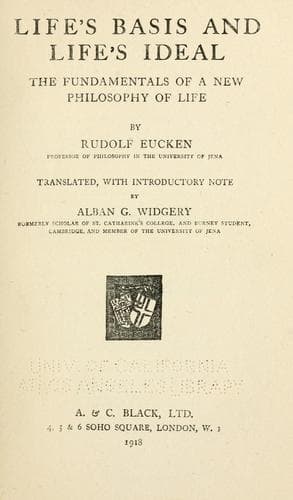
Life's Basis and Life's Ideal: The Fundamentals of a New Philosophy of LifeEucken, Rudolf
Philosophy
Life's Basis and Life's Ideal: The Fundamentals of a New Philosophy of Life
Eucken, Rudolf
Life; Ontology
subject that has lost its spiritual content is but a mere semblance of
help, which deceives us concerning the seriousness of the situation with
sweet-sounding words like "personality," "individuality," and so forth.
If the spiritual life is not strengthened and does not energetically
counteract this tendency, then, notwithstanding all external progress,
we must inwardly sink lower and lower.
It is obvious that there is already such a counteraction in existence;
otherwise, how could spiritual destitution and the insignificance of the
merely human be so keenly felt in the present; how could so ardent a
desire for an inner elevation spread amongst men as we experience it
around us? There is no lack of attempts and endeavours after new aims
and new ways. But much is still lacking for these attempts to be equal
to satisfy the requirements of the matter. We place far too much hope
in external reforms, instead of primarily strengthening the inner basis
of life; we fix our attention far too much upon individual tasks instead
of seizing the whole; we have far too much faith that we can rise to a
new life out of this chaotic condition, instead of insisting upon an
attainment of independence in relation to this condition.
How could independence be attained except by an energetic reflection of
man upon himself, upon his fundamental relation to reality, upon the
life dwelling in him, in short, except by self-consciousness? It is not
the first time that, in the course of the ages, to satisfy such a demand
has become the most urgent of all tasks. The work of history has not
unshakable foundations from the beginning; but the spiritual nature of
epochs always involves the activity and the decisions of man; it
involves, therefore, presuppositions that for a long period may be
accepted as established truths, and which, yet, finally become
problematic. At the beginning of the Modern Age, especially in the
transition to the Enlightenment, apparently established truths became
problematic in this way: the present is in a similar situation. The
threads that we have hitherto followed break; all external help is
rejected, as is also the authority of history; nothing else remains to
us than our own capacity, and the hope to find in it a new support and
the basis for a new construction. Only by our own power, and after a
break with the immediate present, shall we be able to strive after a new
idea of culture which corresponds to the historical position of
spiritual evolution, and which can take up into itself the experiences
of humanity. Such times of error, of vacillation, of searching, of
necessary renewal, are disagreeable and severe, but it depends only on
the summoning of spiritual power whether they become great and fruitful.
For, with regard to these central questions the times do not make men,
but men make the times, not, of course, in accordance with their own
preferences, but by seizing and realising the necessities that exist in
Public-domain text, read in full here on John Shaqi.
Reviews
Reviews
No reviews yet
Be the first to share your thoughts on this work.
Elsewhere in the archive
Join the Discussion
Join the discussion
Sign in to leave a comment or review.
Sign InorCreate an account