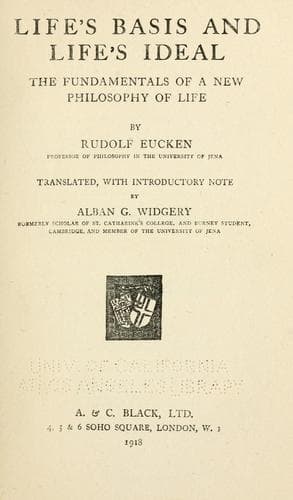
Life's Basis and Life's Ideal: The Fundamentals of a New Philosophy of LifeEucken, Rudolf
Philosophy
Life's Basis and Life's Ideal: The Fundamentals of a New Philosophy of Life
Eucken, Rudolf
Life; Ontology
particular the resort to Goethe, as to one with a secure standard of
life, is in general no more than an expression of perplexity, no more
than a flight from a clear decision of our own: the universality and the
flexibility of his spirit permit a point of contact with him to be found
by those whose views directly contradict those of one another, and
allows each to abstract, and make a profession of faith of that which is
preferable and pleasing to himself.
Thus to-day we are in a state of uncertainty and indefiniteness in
reference to the problem of culture. Since the new does not suffice, and
the old cannot be taken up again, we are in doubt with regard to the
whole conception of culture; we know neither what we have of it nor what
it demands from us. We cannot give up our claim to being something more
than nature, without sinking again to the level of the mere animal; but
in what this "more" consists and how it is at all possible to surpass
nature is to us completely obscure. A developed historical consciousness
and the free unfolding of the powers of the present permit many things
to rush in upon us; and we are involved in much inconsistency. We have
seen diverse systems of life arise and attract man to themselves; their
conflict relegates to the background all that is common to them,
produces the greatest uncertainty, and gives rise to the inclination, in
order to avoid all perplexities, to regard life as being made up
entirely of that which occurs within sense experience; and to acquire
aims from this experience, as well as to derive powers from it. But in
this we fall into the danger of idealising sense experience falsely,
and of expecting achievements from movements within it which are
possible only if these movements flow from deeper sources. We flee to
morality to become free from all religion and metaphysics; as though
morality, elevating man, as it does, above simply physical preservation
and the compulsion of mere instinct, is not itself a metaphysic, and as
though it does not of necessity require the existence of an order
superior to nature. Then we flee to the subject with its unrestrained
inwardness and contrast this inwardness with all the restricting
relations of life; as though the subject had any content and any value
without an independent inner world, the recognition of which involves a
complete revolution of the representation of reality; as then according
to the witness of history also humanity has reached such an inner world
only through wearisome toil and forceful resolutions. The whole course
of Antiquity had been leading up to this inner world, but the collision
of Antiquity at the time of its decay, with Christianity which was then
arising, first developed it clearly. Such an inner world must ever be
justified anew; and for this our own activity and conviction are
necessary. If we surrender its basis, it becomes dead capital which,
little by little, is inevitably spent, and then the appeal to the
Public-domain text, read in full here on John Shaqi.
Reviews
Reviews
No reviews yet
Be the first to share your thoughts on this work.
Elsewhere in the archive
Join the Discussion
Join the discussion
Sign in to leave a comment or review.
Sign InorCreate an account