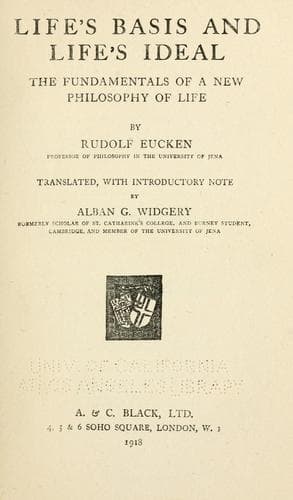
Life's Basis and Life's Ideal: The Fundamentals of a New Philosophy of LifeEucken, Rudolf
Philosophy
Life's Basis and Life's Ideal: The Fundamentals of a New Philosophy of Life
Eucken, Rudolf
Life; Ontology
Not only the conception but the whole nature of that which is called
culture is an unstable hybrid. It should elevate man above nature, and
give to his life a characteristic spiritual content; but at the same
time we have a dread of a detachment from the experience of sense and of
the construction of an independent world, because these must lead to
that which, of all things, is the cause of most alarm, to a change of a
metaphysical character, to a transformation of existence. In truth, in
the work of humanity two tendencies are usually undistinguished, which,
if life is to continue to advance, need to be distinctly separated: a
spiritual culture and a merely human culture. The former reveals new
contents and aims; with it a new world emerges within man, and
transforms his life from its basis: the latter uses that which a higher
organisation has given us, solely as a means for the advancement of our
natural and social existence. Merely human culture turns the spiritual
into a mere means to increase narrowly human happiness, whereas the
spiritual by its very nature makes us feel the whole of this happiness
to be too insignificant, indeed intolerable. The difference of a merely
human and a spiritual culture extends from the fundamental disposition
to all the separate departments of life. Religion, for example, is to
the former a means by which the individual may make himself as
comfortable and as secure as possible in an existent world, and conduct
his own insignificant _ego_ through all dangers; to the latter, it
signifies a radical break with that world and the gain of a new life, in
which care for that _ego_, or even the state of society, is relegated
completely into the background. To the one, morality is simply a means
in the organisation of human social life, in the accommodation of the
individual to his environment; to the other, it discloses a new
fundamental relation to reality, and in the transformation of existence
in self-determining activity allows life to win an inner union with the
infinite and its self-consciousness. On the one hand, art, science, the
life of the state, education, and so forth are the idols of utility, of
expediency, the adornments of a given existence; on the other, they are
the gods of truth, of inner independence, of world-renewing spontaneity.
That there should be an end to the confusion of the worship of idols and
of gods; that spiritual culture should be distinguished from merely
human culture; that the spiritual content of the individual departments
of life should be energetically developed, and the spiritual poverty of
merely human culture made clear--all this is the urgent demand of the
present, without the fulfilment of which its state of confusion cannot
be overcome. Yet spiritual culture can never become independent unless
the spiritual world is independent. Only the presence of this spiritual
world makes it possible for culture, at the level at which it is
Public-domain text, read in full here on John Shaqi.
Reviews
Reviews
No reviews yet
Be the first to share your thoughts on this work.
Elsewhere in the archive
Join the Discussion
Join the discussion
Sign in to leave a comment or review.
Sign InorCreate an account