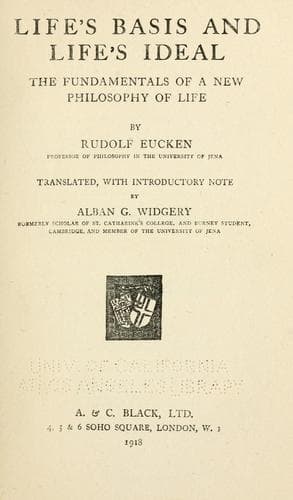
Life's Basis and Life's Ideal: The Fundamentals of a New Philosophy of LifeEucken, Rudolf
Philosophy
Life's Basis and Life's Ideal: The Fundamentals of a New Philosophy of Life
Eucken, Rudolf
Life; Ontology
generally found, to be tested by a transcendent standard to see how much
spiritual substance, how much content and value, it contains. This test
will prove that we possess far less spirituality than we think; and that
the most of what is called culture is no more than the semblance of
culture, no more than imagination and presumption. But at the same time
we recognise and gain in the little spirituality that remains to us
incomparably more; we win the presence of a new world, and by this,
depth of life and the possibility of an inner renewal. Our life would be
indescribably shallow if it were to pass on one level and were to be
exhausted in the experiences at that level. The acknowledgment of an
independent spiritual life saves us from this shallowness, in that it
shows an inner gradation within our own province and sets life as a
whole a task.
If the acknowledgment of a spiritual world, inwardly present to us,
gives to culture a distinctive character, this character receives a
further modification from the particular manner in which the spiritual
life makes its appearance and becomes established within our existence;
at the same time, from this position there is also the possibility of
different sides and tasks within an all-comprehensive work of culture.
Of special significance in reference to this modification is the
circumstance that the spiritual life does not possess man as a natural
fact, does not operate within him with complete power and sure direction
from the beginning, but is present to him at first only as a
possibility, and as a transcendence of the general condition of things.
In accordance with this, although the spiritual belongs to our nature,
it is not so much "given" to us as set as a task; for its realisation it
needs our own attention and appropriation; all development of the
spiritual life within us, therefore, involves our own activity and so
receives an ethical character. The spiritual life also has such an
ethical character because, transcending our original condition, it must
be conveyed to us, and must be maintained by an imparting and an
activity. In the spiritual life we find ourselves in a sphere of
activity and of freedom in contrast with that of nature; in this way our
life becomes our work, our own life in a much more real sense. We see
this in the case of the fundamental form of the spiritual life that is
called "personality." We men are by no means personalities from the
beginning; but we bear within us simply the potentiality of becoming a
personality. Whether we shall realise our personality is decided by our
own work; it depends primarily upon the extent to which we succeed in
striving beyond the given existence to a state of self-determining
activity. The fact that we thus take part in the formation of our own
being proves that we are citizens of a new world--a world other than
nature--and shows that we are incomparably more than we could become
simply as parts of nature.
Public-domain text, read in full here on John Shaqi.
Reviews
Reviews
No reviews yet
Be the first to share your thoughts on this work.
Elsewhere in the archive
Join the Discussion
Join the discussion
Sign in to leave a comment or review.
Sign InorCreate an account